Choosing Your First AirBnB

AirBnB has been truly great to us and we can’t recommend them enough. Every type of lodging is available: tree houses, huts, beach cabanas, modern flats and castles! Search functions allow you to search for a private room, a shared space, or the entire home. The prices vary as much as the style, meaning there is definitely a listing for your taste.

For accuracy in prices and availability, put in the dates you’re looking to stay, even if they’re tentative because you may find a place you like that happens to have a flexible host. It’s no fun to get super attached to a listing only to find out it’s not available. 😦

Before booking, check the cancellation policy. Each listing has one: flexible, moderate or strict. Flexible means you can cancel no later than 24 hours before your intended stay for a full refund, which is best for more spontaneous bookings. Moderate means cancellation must be made five days (in host’s local time) before intended stay for a full refund.  If you’re planning to attend an event or you’re pretty sure you won’t change plans, this is an option. Strict is… Strict. No full refunds are offered for Strict cancellation policies.  Instead, a 50% refund will be given for cancellations made seven days or more before your intended stay.

We’ve found the hosts to be quite delightful and to ensure you get the most out of your stay without any misunderstanding, we always message the host before booking. We also crafted a template to familiarize you with the site and ensure you ask vital questions with a message like this:

Hello, My husband and I are traveling to London from September 23 to September 28- confirming you have these dates available. We are mainly looking forward to visiting Westminster Abbey, Tower of London, and Camden Market. We would like to prepare a couple small meals as well. We will be arriving from Heathrow at 7pm- would you be home at that time? What is the best tube route to your location? 

Thank you kindly. 

Most hosts respond within two hours as they are eager to confirm guests :). Generally, a more outgoing, interactive host will respond with a more detailed message. Ask for recommendations in their area. If you’ve any allergies, it’s good to note that so the host can accommodate. We had an instance where a review noted a pet but the host didn’t, so if pets are something you need to avoid, confirm before the booking. At a different stay, I was totally under the impression the host would be there, but he didn’t live in the area anymore; the house was a rental property. For a first time stay, you may want to ask if there will be other guests in the house.

For short stay travelers looking to maximize time, ask:

  • What do you find is the best way to get around?
  • Is Uber operating here?
  • What times do the trains/ buses run?
  • Additional charge on public transit during peak travel times?

For super savvy and aspiring long term travelers, ask:

  • How far is the nearest market and when does it close?
  • How far is the nearest pharmacy?
  • Do you have ample pots and pans, flatware and cooking tools?
  • Do you have a clothes washer if I bring my own detergent?

For families of four or more, we recommend:

  • Selecting “entire house” instead of one room as a search filter. More privacy, flexibility and importantly security.
  • Booking as soon as possible if you’re attending an event. AirBnB hosts will raise prices too, sometimes three months in advance.
  • Letting the host know the ages of your children, especially younger tots.
  • If you rented a car, ask where the car can be parked. 

Final note: Give a host with no reviews a chance. We did and had a lovely stay!

Have you had an experience at airbnb you’d like us to feature? Let us know! We would love to hear your travel adventures.

Mark and Melody
London on a Budget: Don’t Forget This! 

When looking to travel in a big city like London, it’s easy to be seduced into picking the lowest price for hotels/ lodging. We found out the hard way that the cheapest place actually ends up costing more…

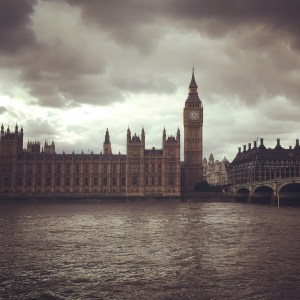
Big Ben.

How? Because time is valuable too. 

Our 100+ day journey (no return ticket!) started with a week in London, so this is sage advice for long journey travelers and ambitious tourists who believe they can absorb London in a week.

It’s hard to find a way around London being pricey: bargain hotels start at $130 USD near the main attractions and hostels are mostly dorm style. AirBnB is typically the best way to get quality lodging at a deeply discounted rate. Unless you’re the worlds greatest hotel rewards points collector of course, in which case, don’t be afraid to share.

After looking into our options, we found a beautiful little place ‘just outside of London City Center’ for a modest $38 per night. That’s just $19 per person, per night. We had a nice little kitchen to cook in and a living room – excellent!

We flew ‘Into London’ (rolls eyes) and began working our way toward the house. Color me surprised to find that it would take us nearly an hour and a half via train and underground to get there.

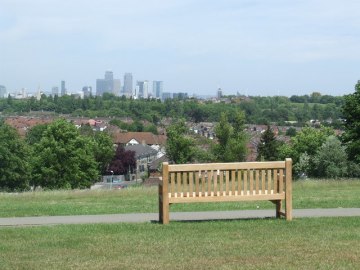
Geograph-2430114-by-Malc-McDonald

Transit into London came at a steep cost of $77 via train on the express, taking about 45 minutes. Buy your ticket in advance and you might not get taken advantage of like we did. After another two transfers, we ended up on the train that would take us 45 minutes outside of London City Center ($4). We then walked / climbed the hill that brought us to the house we would call home for the next week.

Side note: This hill did not mess around. It puts San Francisco to shame. I’ve been on trail hikes less exerting than this. I felt like a winded mountaineer. What’s worse is these delightful little British kids are running all up and down this hill like it’s the easiest thing they’ve done all day. Ah.  Good ol days.

EVERY day we went into London to visit the Tower of London, or Tower Bridge, or the Beefeater Gin Distillery, or to visit a random park to have lunch, we were literally travelling uphill both ways. So that’s what my grandparents meant.


We took the bait for the cheapest place and paid a lot in time; over 18 hours was spent traveling to and from London city center which was $148 in fare over seven days for two people. The underground, overground and Thameslink train are surprisingly inexpensive, but we definitely could have used that 18 hours to spend another day at the Imperial War Museum, the National Gallery or the British Museum. 

Taking into account travel costs, the weighted cost of lodging became $415 – not taking into account our time (which of course everyone values differently). That brought the nightly rate to $59.29 or $29.65 per person.

We may have been able to find something that was more accessible and end up spending the same amount (or less), by opting for something a little higher in initial cost.

Pro-tips:

London’ is broken up into six zones. Zones one and two are where most of the popular attractions are. We were technically staying in London, but zone six, which was an hour away from the center. A trip to the Jewish Museum, a little further afield, was over 90 minutes away and back.

If you are staying at an airbnb (which we totally recommend) please ask them what zone they are in and what station they are near. Give us a shout if you need help deciphering the infamous London Underground map. 🙂

Think about how much time you want to spend getting to your points of interest each day, and always account for potential delays when you are further away. Remember – time is money!

Cheaper accommodation usually sacrifices: Convenience, Amenities, and/or Access to Transit. Even if you do not mind spending more time in transit, always take the everyday travel cost into account when making your decision.

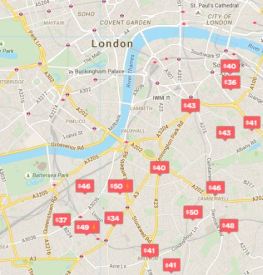
AirBnB London

Consider a slightly more expensive accommodation to save yourself time or money overall. Looking back now, we could have spent $40-50 per night at a different AirBnB and found ourselves at a spot near London City Center, which would have saved us $65-135 – not to mention the time we spent and the stress incurred by the longer transit.


Whether you are on a mission to visit every country in the world as we are, or you’re just looking for a quick getaway to a world city, we hope that the information here might prove enlightening whilst you are planning.

Please send us a note of the travels you wish to embark on, and don’t be afraid to let the travel bug bite.

Mark & Melody

Our Backpacking Gear – What We Use

This details our first attempt to follow this sage travel advice: “Lay out everything you want to pack. Now put half of it back.”

It’s really difficult to do. I began to think of all the possible scenarios in which I would need my makeup bag, three different kinds of yoga pants because it might be cold, or it might be hot. I wanted to bring ten tank tops because I love to layer, and I wanted to bring athletic shoes, hiking shoes, dress sandals and a pair of casual sandals because I want to make sure I’m accessorized and equipped for any occasion I may encounter.

But I’m carrying all this shit around for five months and that puts things in perspective. If you’re packing and you can’t lift your pack with one hand, IT’S TOO MUCH STUFF. And if you think it isn’t heavy, walk around your neighborhood for thirty minutes and reassess. If I had done that I’d have about a third of the stuff I do now.

We used the Kelty Redwing 50L Backpack ordered using Amazon Prime. We picked these packs for the following features:

    • Carry-on compliant for Ryanair, AerLingus, Norwegian. Win.
    • Front zip so the pack unzips much like a suitcase
    • Functionally sized side and top compartments
    • Highly adjustable shoulder, waist and chest straps – paramount for comfort and avoiding injury!


Melody’s Clothing:

Outerwear: one fleece jacket from Poshmark, one waterproof North Face jacket (lost in Istanbul).

Tops: Four long sleeve, three short sleeve, two tanks.

Bottoms: Two Jeans, One Yoga Pant, One skirt, One Pair of Shorts.

Little things: Two bras, one sports bra, one bathing suit, ten underwear, 1.5 pair of socks*.

Shoes: Leather Sandals (Aldo), Merrell Women’s Moab Ventilator Hiking Shoe

These hiking shoes have walked through farm mud, forest mud, slippery rock faces, sludgy trails, and everything in between. They provide enough stability for the ankles for a moderate hike, up to six hours in length.

Mark’s Clothing:

I think he overpacked, but he was prepared. His pack weighed over 20 pounds before we even left.

Outerwear: 1 insulated Calvin Klein jacket

Tops: 5 t-shirts, 3 long-sleeve shirts, 1 button down,

Bottoms: At least four trousers plus work pants, 1 pair of athletic shorts

Little Things: 10 pairs of boxers

Shoes: Running shoes, hiking shoes, casual shoes, and flip flops.

However, when we were ten days between laundry facilities, I was the one re-using clothes, not him. I’m actually surprised he didn’t run away when I was on my second or third wear of t-shirts.

That was my world of traveling light.

Electronics:

  • 1 17″ Dell Laptop
  • 1  iPad Mini
  • 1 iphone 4s
  • 1 iphone 6s
  • 2 Apple charging blocks
  • 2 Apple USB cables
  • 1 Car charger
  • 3 power adapters
  • 1 power converter block
  • 1 13″ Macbook Air*
  • 1  Nikon D5200
  • 1 External Hard Drive
  • 6 SD cards with carrying case
  • 1 Digital Camera Tripod

What Weighed Us Down

Melody:

  • Leather gloves – total waste in damp climates
  • Chi flat iron – adorable that I thought between the farming and touring a city I’d flat iron my hair. Nope.
  • iPhone 4s  –  used to send departing texts from Ft. Lauderdale on July 7th and never again
  • iPhone 4s charger
  • Oversized messenger bag – doubled as daypack and purse
  • Bulky plastic water bottle –  for refilling at water fountains but there’s never one around
  • Makeup bag. I gave up with makeup somewhere in August in Finland.
  • Nikon D5200. No getting around this. It’s heavy.
  • Two textbooks for my online classes

Mark:

  • 17″ Dell laptop – I wound up carrying this
  • Aluminum water bottle – bulky and makes the water taste funny

What We Tossed:

  • Mark traded his Nike free runs & Sketchers dress shoes
  • 4s iPhone Charger
  • Dead iPhone / iPad Charger
  • International Power Converter from Brookstone. All we needed for the phones, iPads and laptops were a handful of adapters.
  • Plastic and Aluminum Water Bottles
  • Melody’s mascara, eyeliner, ‘cheap’ foundation
  • Bra
  • Pairs of socks that got irreparably dirty

What We Bought:

  • Mark swapped two pairs of shoes for these NorthFace  Gore-Tex Hiking Shoes found at a TKMaxx in the UK.
  • Digital Camera Tripod from a Kodak Store ($30)
  • Full-size shampoo & conditioner to refill our many empty travel toiletries
  • Travel journals
  • *Macbook Air
  • International Power Adapters
  • Awesome Feetures Elite Ultra Light Socks. These make any shoe instantly comfortable with a compression band built into the sock that supports the arch of your foot. Translation: With these socks, you really can walk 500 miles.


What We Wished We Had:

  • Wool gloves for cold days
  • Box of Earplugs
  • Airplane Sleep Mask – the best one is this Alaska Bear sleep mask
  • More hand and face lotion
  • Emergency snack kits that we made before 5, 6 and 7 hour bus rides.
  • Cheap flip flops to walk around hostel in or to the car.
  • Slip-on sneakers. Many countries in Europe have a custom to leave your shoes at the door, and it gets frustrating untying and retying your shoes every hour or so.


Takeaway: You need a lot less than you think you do, especially if you’re traveling  from America. We wore the same week’s worth of clothes for five months and you’ll surprise yourself with the mileage you get out of your stuff. Make all of your clothes the same color-scheme (pinks, reds, and oranges or blues, greens, and browns) and you’ll go quite a long way.


The Oystercard Doesn’t Get You to London Airports, and other London Travel Tips

More about the benefits of an Oystercard and why you should by one in London here, but it’s a little known fact that it doesn’t cover transport all the way to ANY of London’s major tourist airports: Gatwick, Heathrow or Standsted. Instead, each airport offers its own express train. 

For flying into London Gatwick, please note, it’s about two hours from London City Center, so please calculate an additional $70 USD/ £40 for two people for the Gatwick Express to Victoria Station. From there you can buy an Oystercard and get just about anywhere in London via the tube/ underground. 

For flying into London Heathrow, it’s about an hour from London City Center. The Heathrow Express travels to Paddington station in 15 minutes for about $30 / £21 if you purchase in advance. To buy the Express ticket upon arrival into an airport it’s an additional $8 / £5 per ticket. 

For flying into London Stansted, there are two public transport options to get near city center. For $14/ £9, a 55 minute bus ride will take you from the airport to Liverpool Street. For $27/ £18, a 45 minute Stansted Express train will get you from the airport to Liverpool Street. 

NOTE: once you get to Liverpool street, you can use your Oystercard to get anywhere else on the tube, the overground, or the bus system. 

If you’re traveling with a group or you don’t want to deal with inevitable crowds, a third option is a taxi from Stansted which costs between $120-150 (£80-£100), though I’ve never taken it. You’re better off downloading the Gett app and hailing a taxicab that way. 

This is important so I’m saying it twice: buy your Oystercard in London. Do not get a travel card. Do not buy one-way tickets.  And please look hard at the London Pass before subscribing. The Oystercard lets you travel like a Londoner through nearly all the zones and you can refill/ top up the card as you go. 

Happy travels! 

Your Survival Guide to Driving in Scotland

The scenery in Scotland is world class. Traveled to over a dozen countries and it’s truly some of the most majestic landscapes I have ever seen. Scotland deserves independent exploration, some time to get lost in the incredible greenness of the area. After some frustrating, laughable trial and error, we can give you this must know list to make driving in Scotland much easier. 

There are four types of roadway: M, A, B, and C. The M stands for motorway, and that’s your typical highway (ex, M6, M74). A is secondary road, a busy two or four lane road (ex, A735, A82). B and C are curvy, narrow, back country roads.

The speed limit on these roads are in MILES PER HOUR, not kilometers per hour:

M roads: 70 mph

A and B roads: 60, but sometimes required to slow to 40 or 30 mph

C roads: 30 mph

This was discovered when we were going 60kph (37 mph) on a motorway designed for 60mph. No wonder we were getting passed right and left! Speaking on passing…

Odds are if you’re visiting Scotland, you come from a country that drives on the right. Your highways have the slow lane on the right, entrance and exit ramps on the right, and the fast lane on the left, toward the middle of the highway. In the UK, people drive on the left. This means the slow lane is on the left, the entrance and exit ramps are on the left and the fast lane is to your right. If you need to pass someone, you will be moving left to right. 

Love roundabouts. Scotland uses roundabouts instead of stoplights, so your GPS will be prompting you to take exits off roundabouts with about the same frequency you stop at a light in your hometown. Some of them are quite large, while others are the size of an intersection in a suburb community. Enter roundabouts by turning LEFT. 

Signs approaching a dangerous curve or severe dip in the road will tell you to slow down but not tell you what speed to reduce to. Generally reducing speed by 5-10mph will yield a more comfortable turn. But if you’re in a sports car and you want to power slide or attempt to drift,  just maintain and you’ll get a good thrill.

Drive during the day only. In the summer, the sun doesn’t set until 10pm. Many of the A, B and C roads are without street lighting which can be very dangerous. 

Taking a car around Scotland has proven to be taxing on the body and mind, especially with a manual drive car. Nearly all rental cars in the UK are manual: automatic drive is about twice as much. However, the scenery is more than rewarding and more than worth it. 

Safe travels! 

How A Missed London Flight Became the Best Day Ever

We had a flight from London-Gatwick to Oslo scheduled to depart at 6am. Following the guidelines of international flights, we decided to be there about 90 minutes early: 4:30. We were staying at Masslink Guesthouse so across the street from the airport. The alarm is set for 4am.

It doesn’t go off. Something wakes me up around 4am, but it’s not the alarm. I go back to sleep.

I wake up about an hour later, suspicious of how rested I feel. Light is peeking through the curtains. I know it’s not 4am. My eyes glaze over to the clock and in big red letters it proudly displays… Continue reading

Eating in Oslo is Outrageously Expensive

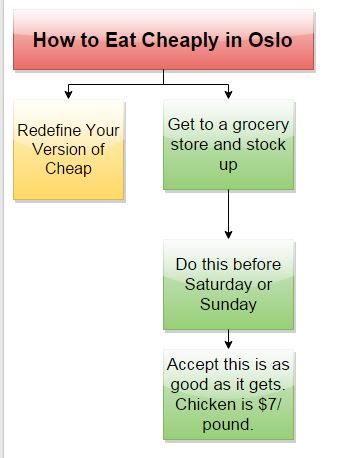
Eating Diagram

Oslo may no longer be the world’s most expensive city (it lost that rank in 2013), but it is still outrageously expensive. Unfortunately, for budget travelers looking to spend $50 USD or less, there is not a lot to do other than walk. Happy hour doesn’t exist here. Eating on the cheap doesn’t exist here. Thankfully the couple we are pet-sitting for left a fridge with some foodstuffs in it because otherwise we would DIE.

At an Irish pub, $120 was spent in Oslo on 2 Guinness, 2 ciders, a chicken club sandwich, Irish stew, and a whiskey.

We thought, no worries (actually Mark was like “WHAT!”), we’ll just eat from convenience stores and gas stations…

At a Shell gas station, $30 was spent on a Coke ($4), water bottle ($4), two Snickers bars, a muffin, and two hot dogs.

We learned that the city pretty much shuts down in July and it is cheaper to spend a month anywhere else in Europe than it is to stay in Oslo. We learned this after we walked around Oslo looking for cheap eats courtesy of Yelp, but two of the places we went to were closed.

We wound up… at a Norwegian version of Chipotle (one of two places open) where two burrito bowls cost $30.

We’ve finally given up on dining out, even as a treat, so we relegated to finding the grocery store. Only to discover…

Grocery stores close at noon on Saturday and are closed on Sunday.

When I said I wanted to lose weight, this is not what I had in mind.

Don’t Rush into the London Pass

We almost bought them. It seemed like a great deal, which is reason to be all the more suspicious of it. In short, it gives you access to 60 attractions for one, two, three or six days, including things like Tower of London, Westminster Abbey, a Tower Bridge Experience, Windsor Castle, Globe Theatre, and a Thames River Cruise. The price for the pass goes up naturally with the number of days you plan on using it. It all sounds perfect, right?

Here’s why I didn’t get it. You have to see a whole lot of attractions in order for the pass to save you money. For example, I wanted to see:

Tower of London: 22
Westminster Abbey: 20
Beefeater Gin Distillery Tour: 12
Chislehurst Caves: 6
Jewish Museum: 8

Equalling 68 pounds. In order for the pass to save me any money, I would have to do these things in one day with the one-day London Pass, which costs 52 for an adult, which is frankly insane for the following reasons:

  1. We were at the Tower of London (where the Crown Jewels are) for over three hours and made it through the history of currency and mint exhibition, the White Tower, the Crown Jewels, and the Bloody Tower. There’s no way to see the entire Tower in less than half of a day.
  2. The Beefeater Gin Distillery is across town and takes another two hours in itself.

We took pictures of Westminster Abbey (not all that interested in the lineage of the royal families) and haven’t made it to the other attractions but the point of this is:

You would have to be hustling through major points of interest to save any money with the pass.

What would you prefer – spend a little more money for a lot more leisure, or save a little money for a lot more stress (and possibly pain?)

BUT, If you insist on purchasing the London Pass, please pick it up from a vendor in London. Buying it online will cost you an additional 10 pounds or more. (We saw rates much cheaper in London in person).

Leave comments with questions. We’re happy to elaborate.

Cheers.

xx

Travel Diary: Battling Sickness in the United Kingdom

You don’t always need to catch a virus or get invaded by bacteria to get sick. Sometimes you try to do so much, so quickly, with such vigor, that your body literally breaks down and forces you to stop.

That’s what happened. After walking about 30 kilometers (18 miles) over 2 days, our bodies said, “Enough.” Naturally, we went on a hunt for some pain relief. In the UK, the equivalent of a CVS/ Rite Aid is Boots. Boots has a bunch of cosmetics as well as a pharmacy and some minor first aid items. We picked up some throat losenges we thought would do the trick.

No dice. Earlier today I went to an establishment that said simply ‘Pharmacy’ on it. I went in and that’s exactly what it was. Two pint-sized aisles of what seemed like space-filling items, and a whole wall after wall of drugs behind a pharmacy counter that a young pharmacy student was manning. After a bit of browsing items that had absolutely nothing to do with my pain, I walked up to this pharmacy student and said simply, “I have sinus pain and a fever. What should I get for that?” He simply nodded and turned to the pharmacist, who scanned the myriad of shelves for an item and handed me some intense looking sinus/ fever reducing SudaFed (4 pounds).

The main purpose of this is to illustrate that you cannot buy any pain relieving/ fever reducing/ cold or cough suppressants without first speaking to a pharmacist. You go up to them, or queue up (wait in a line) to talk to them. No charge. You tell them your ailments, and they fix you.

Note: Please tell your pharmacist what you’re taking or if you’ve had any alcohol or aspirin in the previous 48 hours. They don’t always prompt you for this. Anything, even contraception pills, can have adverse reactions when taken with certain medication.

What We’ve Learned After 3 Days in London

Our first stop on our 111 day journey around the world takes us to London. What a city. We had a lot of expectations, both of ourselves and of the city. Here’s what we’ve learned with a little bit of tough love from one of the world’s most cosmopolitan places, and see this link for how to do London on a Budget.

1) This is not a bargain town. With the USD-GBP exchange rate, we’re getting about 64 pounds for every $100 USD. Here’s a point of reference, all prices in pounds:

Cheap beer: 4
Nice beer: 6
175 ml glass of wine: 6-8
Appetizers (half the size of American apps so a bad substitute for dinner): 9-12
Cheap dinner: 13
Filling Dinner: 20-30

So you can see, a nice (non-budget) dinner for two could easily eat up your 64 pounds.
In other words, you’ve just spent $100 on one meal.
No tipping here. Please don’t do it. And no added-on tax. The price you see on the receipt is what you pay.

Picking up foodstuffs from supermarkets or grocery stores is key to saving money.

Cold/ Flu Medicine: 4 [please see note here about pharmacies in the UK]
Small bottle of water: 1
Large water: 2
Takeaway pasta from grocery store: 4 (or you can get lucky with a 3 for 3 deal at Sainsbury’s)
Box of tea: 2

NOTE: There are Panera Bread type places where you can purchase coffees, smoothies and bread items, but you will see two prices: a takeaway (to-go) and eat-in price. The eat-in prices are higher because of a VAT (value added tax) charge. Our suggestion? Get your items for takeaway and eat at one of the numerous parks and green spaces.

2) Please be extremely mindful of the amount of walking/ stair-climbing you do. It is very easy to wear out your body and thus make yourself sick. London is very walkable, but please please plan your visits to attractions in clusters and plan for no more than three attractions a day. It is not necessary to visit the Imperial War Museum and the National Gallery in the same day. They are on opposite sides of town and there is plenty in each “zone” to keep you busy for an entire day.

3) Buy an OysterCard the day you arrive (and think twice about the London Pass). They’re available at the airport, convenience stores, kiosks, and supermarkets. It gives you access to the tube (underground subway), the overground (above-ground subway), and the buses for very low prices. We took a bus during the tube strike: they’re great. Note: As of July 2015, the tube does not run 24 hours; in September 2015, 24 hour tube operations are scheduled to begin.

4) If you have an unlocked phone that can take a different SIM, we strongly suggest you seek out a LycaMobile SIM for 1 pound. The plan we purchased was 17 pounds and came with 2000 minutes, 5GB of data and unlimited text messages. This means we can load maps on Google with the route/ directions, put the phone on airplane mode to save battery/ data, and use the pre-loaded map. Genius. It works. It saves battery. We haven’t gotten lost.

Cheers.

xx

Snorkeling at John Pennekamp State Park – Know Before You Go!

As part of our ambitious desire to visit every state park, we thought a snorkeling adventure at John Pennekamp Coral Reef State Park would be an easy and fun addition to our list. We called the snorkeling crew down in Key Largo and made a reservation over the phone a day before. The next morning, we made the drive to Key Largo.

The park is easy to find with plenty of signs directing you. Like any other state park, it’s a $6 entrance fee to the park for a car with 2-8 people. With your receipt you’re given a map of the park and some history of the area.

After you park your vehicle you’ll see an education center with some wildlife and conservation information. A little further and you’ll see the area where you’ll check in, which is the gift shop and activities check-in desk together..

The conditions for the water are listed on a whiteboard when you go to check in which details the level of choppiness and visibility in the water.

They have mask, snorkel and fin rentals available in case you don’t bring your own, but I definitely suggest you find your closest WINGS store and pick up a set there. Buying a mask/ snorkel set at Pennekamp will cost a hefty $30.

Fortunately, the people at John Pennekamp don’t make you pay in advance. Unfortunately, we and two other people signed up for the snorkeling adventure and drove about two hours to get to the park. We got to the counter, big-eyed and bushy tailed, ready to snorkel to our hearts’ content when we were told…

The water is too choppy. We might not be running the tour today. If we do run the tour, you will need to be an experienced snorkeler and a strong swimmer.

FYI: I’m not the world’s strongest swimmer. Mark’s never snorkeled. The couple we were with had both snorkeled and swam, but they weren’t keen on bobbing about in choppy waters. We decided to have lunch and see how we felt about going. When we went back inside, we were told that the waters were still really choppy (the wind was gusting at about 15-20 miles per hour) and good visibility wasn’t guaranteed.

Translation: The current is kicking up a bunch of sand and you might not actually see shit.

With the tour being about $40-50 a person including the gear rental, we decided that going snorkeling on a super windy, super choppy day wouldn’t be the best idea for first-time snorkelers.

Alternative plan: We asked about the glass-bottom boat tour, but were told the choppy waters were churning up the sand and reducing visibility on the boats as well.

So, what’s a group to do in John Pennekamp if you’re not snorkeling/ glass-bottom-boating?

It turns out… not a whole lot.

There are three small beaches where you can put your towel down or post up some chairs, but the sand is packed hard and it’s really uncomfortable to lay on. There’s a few boardwalks, and there’s kayaking, but we went kayaking at Oleta River State Park the day before, so our upper bodies were sore.

We wound up leaving about an hour after lunch and headed to Crandon Park, near downtown Miami, for a classic cityscape photo shoot before driving home.

Pro-tip #1: Make a reservation a day before, then call before you leave and ask about “if the conditions are clear, the waters are smooth, and if we can see the statue.”

Pro-tip #2: Buy your own mask and snorkel, even at a drugstore. It’ll be cheaper and function just the same. And you can keep it.

Ciao!

Travel Plans Update

After much planning, lots of missed sleep, and a good bit of caffeine, we finally have some tentative plans for our trip!

Setting off on the lofty goal of visiting every country in Europe, we realized that our original plan to do it in a little over two months would be…less than ideal. Thankfully, with my new found freedom (and Melody being able to work from just about anywhere) we are not tied to specific dates!

Without further ado, we present our tentative trip:

July 7th Depart FLL to LGW, arriving July 8th

July 8th – 10th : Explore London and Surroundings

July 11th Depart LGW to BGO

July 11th – 15th : Explore Bergen / Fjord Tour / Northern Norway

July 16th – 21st : Home-Sit in Oslo, Norway / Exploration of Oslo

July 22nd Depart OSL to EDI/GLA

July 22nd – 28th : Explore Edinburgh and Glasgow

July 29th – August 4th : Explore Dublin and Surroundings

August 5th Depart DUB to FRA

August 5th – August 13th : Trains from Frankfurt, Germany to Stockholm, Sweden via Luxembourg, Belgium (Brussels & Antwerp), Netherlands (The Hague & Amsterdam), Germany (Bremen & Hamburg), Denmark (Copenhagen), Sweden (Gothenburg & Stockholm).

August 15th Depart ARN – HEL

August 15th – 28th : HelpX in Orimattila, Finland

September 12th – September 22nd : HelpX in Palamartsa, Popovo Bulgaria

September 26th – October 9th : HelpX at Rue Fons De Seix in Seix, France

October 10th – October 25th : HelpX in Argein, France

October 26th – End of year : Still up for decision.

If you have any ideas on places to visit or things to see / do, do let us know. We have much left to do before we depart, so now I’m off to work on pack fit-out.

Until next time!

Don’t be afraid to let the travel bug bite you.

Mark and Melody

Our Most Oft Asked Question: Travel – on the Cheap!

One of the questions that we get most often is, “How can you afford to travel? You must be rich / rolling in the dough / get money from your parents.” While all of these things would make traveling long-term much easier…it just isn’t the case for Melody and I.

Knowing that we would need to find a way to do it a little cheaper, and also knowing the type of trip that we both mutually enjoy, we set out to discover some cheaper ways to travel.

In general, the two largest cost items while traveling will be lodging and food – these are inescapable truths. While it is certainly possible to eat ramen noodles and camp in a tent, sometimes the weather and local culture may just not let that be a possibility (not to mention that would likely become old, very quickly). Striking a little bit of the middle ground, the following are a couple of other options:

  1. House-sit!We would first like to say a big thank you to Hecktic Travels for their amazing blogs and advice, as well as informing us and many others about house sitting as a travel option. Cheers, guys!Anyone with pets that loves to travel knows that bringing their animals along can make for…less than ideal trips. Traveling with a pet is expensive, and depending on your breed of dog / cat / bird / other exotic animal, may not be possible at all. For the longer trips, it is also not possible to leave your animals unattended (you wouldn’t do that, right?).

    Boarding your animals is another option – but again expensive.

    Some are lucky that they have close family or friends to watch after their furry / feathered babies – but again, not always possible for longer stays.

    For people who fall outside of these lovely conveniences, consider having someone come sit your house!

    In exchange for lodging, you can have a trusted and verified traveler stay at your house and care for your animals / property. The requirements for the stays are clearly stated (expectations and duration), and there are even some that are paid – though not very many – your mileage may vary.

    For our uses, we used Mind My House and Trusted House Sitters, but there are many others out there. Not only will you get to visit some unique and interesting destinations, but in most cases your only costs will be transit expense, food and some time commitment. A secondary bonus for people like us who live in a place that having animals is forbidden – you even get to enjoy the company of the resident animals.

  2. Help ExchangeMelody and I both enjoy staying active. We also love to meet new people and immerse ourselves in new cultures – out of the city and away from the tourist areas. Don’t get me wrong, we love to see the sights too, but there is something powerful about the countryside and the people that live outside of the hustle and bustle of the city.Keeping these things in mind, we set out to find a way to immerse ourselves into the everyday life of a local – and save some money doing it along the route. When we came across Help Exchanges, we knew we had found a winner.

    For our uses, we use HelpX – although there are many more sites out there that do the same thing.

    Simplified, a help exchange is an exchange of your time and labor for lodging and food.

    This exchange comes in many shapes and sizes, but the postings usually detail exactly what the expectations are in advance. The number of hours you are expected to work will vary, but most that we have seen are between 20-25 hours per week.

    Some examples of what you might expect to find:

    Hostel Operator looking for help in maintaining hostel. 20 hours per week to include: Admitting guests, making beds, dusting lobby, preparing food, general cleaning. In exchange you will receive private lodging with bathroom. Minimum 30 day stay.

    or

    Looking for helpers to work in the garden with some experience of gardening and growing vegetables to get the spring work done. Four hours work per each nights stay in return for 3 meals per day and accommodation. Double en-suite bedroom and single bed. Fresh food from the garden where possible and all home cooked meals prepared for you.

  3. AirBNBIf neither of the above sound overly interesting, or you are not really interested in working for your lodging / food, fear not! There are other options for you.AirBNB is, in effect, a house / room / couch sharing site designed to allow homeowners the opportunity to earn a little extra income on empty or unoccupied rooms within their home. These rooms are usually priced substantially below what you might find at a hotel in the same area.

    For smaller groups 2-3, this might actually be cheaper than if you were to individually stay at a hostel.

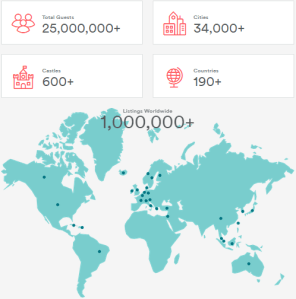
    The site itself is very simple to navigate, and rooms are available in 190+ countries.Capture

    With an available mobile application, the ability to instantly book rooms, and read reviews from others who have stayed, Airbnb is a viable option for those planning far in advance, or on the fly.

For our purposes, we will be using a combination of the three, in addition to some other creative maneuvering to create the most memorable and dynamic trip that we can.

We have almost finalized our rough travel itinerary, so keep an eye out for that soon. In the meantime, keep thinking about that trip you would like to take, and… don’t be afraid to let the travel bug bite.

Cheers!

Mark & Melody

Why Do You Travel? Reply back with yours!

Why would anybody pick this life?
Why would anybody try?
To move about, and run about
And roam from home to home

Why would anybody pick this life?
It heightens all the fears
It wears you out and breaks you down.
It reduces you to tears.

Why would anybody pick this life?
It’s not the path of ease; in fact.
You’ll find it’s just the opposite
But opposites attract

If we get to pick our chains
I hope that restlessness jails me
To a life that moves from plane to train
Destination: I’ve yet to see

If we get to pick our chains
May I be bound to road and sea
To a life that’s redefining
Predictability

If we get to pick our chains
I’ll take my second class billet
Over a plush corner office
And a two-week holiday.

😉

Ciao.

Bucket List in Progress: Every Country in the World

A VERY rough draft of our course in Europe, subject to change based on places we may fall in love with or where we house-sit (more on that in an upcoming post!)
Arriving into London

Starting with Europe!

We have finally decided to take the trip we have talked about for a long while.

To get away.

Explore.

While this has been a thought of ours for a while, it is only through a bit of luck, and a bit of misfortune that we are being given the opportunity. Until February, I was nose to the grindstone – 70+ hours a week devoted to a company. While I learned a great deal in the position that I was filling, there was just something missing. The freedom to travel!

At the end of February, I was laid off due to company cut-backs. While at first this was very upsetting – and certainly a huge shift in the way I lived my life – I am now relieved that it happened then instead of later.

For both Melody and I, few things are more exciting than travel – both planning and executing (see State Signs Tour: I, II, and III). With this newfound freedom we plan to live out, plan and execute a mutual goal to step foot on every country in the world, together – beginning with every country in Europe over the Summer.

While I do not regularly post on here, I encourage you to follow our Facebook Page for more regular announcements from myself and Melody. Once we get a little further into the planning stages, you can expect to see more regular posts both here and on our Facebook where you can follow our progress to see how we are doing with our goal.

Until then, stay well and don’t be afraid to let the travel bug bite you too!