24 Hours In: Prishtina, Kosovo

I lied. We’ve been in Kosovo for three days, but today was the first day we actually went out and explored anything of Prishtina, the capital. We’ve been too busy at the hostel chatting up the guests.

There’s a really good energy about Prishtina, and despite it being a very small capital with a limited number of things to do, it’s quite amazing to be in a place that has been through a hellacious amount of conflict.

Initial observations about Prishtina:

  1. Euro is the currency and cash is king. If you’re staying for 3 days or less, 50 euro should cover your expenses. Yes. This is probably Europe’s cheapest capital city on the euro.
  2. Qepabs (Kebabs) are very popular here and you can get a very hearty plate of meat, salad and the largest bread I’ve ever seen in my life for 3-4 euro.
  3. The 2 liter beers are back! We first saw them in Bulgaria and couldn’t believe our eyes. A 2L of Lasko, the Balkan beer, will cost about 2.75 euro. Drink to your liver’s content.
  4. Tipping is not required. No one expects it. If you need to get rid of your euro change, then tip. You’ll make someone very happy.
  5. The Newborn monument and the Bill Clinton statue are about a 5 minute walking distance apart. In our opinion, the statue looks nothing like him but it’s super fun to chill with Monica’s former flame.
  6. People speak Albanian and English. Mostly Albanian. People love to say that their English is very poor, then go on carrying a full conversation with you.
  7. Good, velvety smooth gelato costs 1 euro for two scoops. Take that, Italy.
  8. Limited number of pedestrian walkways so your best bet to cross a street is to just saunter into the street and rely on the vehicles stopping and waiting for you. I’m still adjusting to this. Mark’s a natural at stopping traffic.
  9. No underground or metro system to speak of. I suppose that’s still in the works.

And the big one…

Getting to other cities! Yes, Prishtina is not a place where you can lose yourself for an entire month (or is it?), so you’re going to want to head to a different place eventually. This is where the internet basically sucks, because anything I can find in English has information that is totally wrong. So, transportation facts:

Traveling Belgrade to Prishtina:

YES: Buses do travel from Belgrade to Prishtina. There are two in the afternoon – one at 12:00 and the other at 4:30pm. If you buy them in Serbia it’s about $20 for two people. Cash only. There are two places at the Belgrade Bus Station to buy tickets. Look for the bus in the number 10 spot.

The trip: About six hours on a bus without WiFi or charging ports. Two stops are made; one in Serbia and one in Kosovo. If you are not an EU citizen, you will have to give your passport up twice at the border; once at the Serbian border, and again at the Kosovo border. We did not get stamps in our books, either.

Traveling Prishtina to Skopje:

This is hearsay as we haven’t done it yet, but the trip is about 2 hours one-way and costs 4 euro. There is both a train and a bus; the train is faster and cheaper but there is only one a day. It leaves at 7:00am and there’s a return train that comes back to Prishtina at 4:00pm. Once we do this trip, as we have to (it’s the closest city with H&M), we’ll update this with absolutes.

Traveling Prishtina to Prizren:

90 minutes away for 2 euro. A prize in Kosovo, really. Prizren is where many Peace Corps members are teaching English for a couple of years, and it’s also Kosovo’s second largest city with many historic artifacts. Definitely worth a day trip, and one we will be taking very soon.

Traveling Prishtina to Tirana:

Mixed reviews on Tirana; some people love it, other people say it’s a “shit hole.” We won’t know until we see it for ourselves. What we do know is that it’s about 5 hours away, so it’d have to be for a weekend, at minimum.

Have questions for this small yet vibrant country? Drop us a line!

Everyone loves a newborn, and we are very excited to spend a month here in Europe’s newest capital.
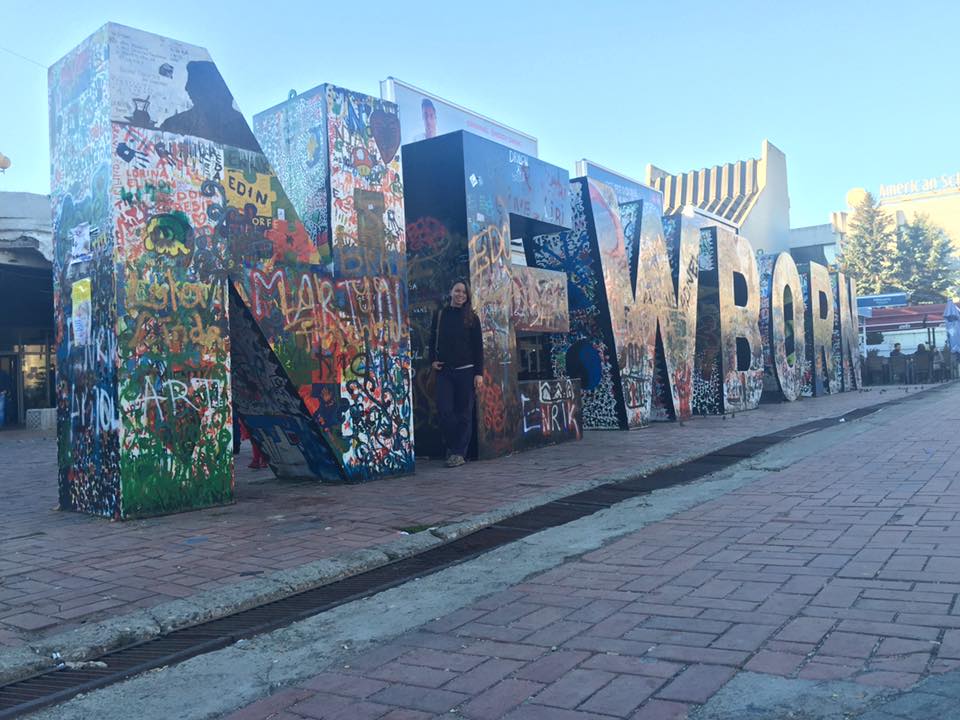
newborn

Cheers!

Prague Must See: The Story Behind the Heydrich Terror Memorial

The National Memorial to the Heroes of the Heydrich Terror is a living, breathing testimony to how the efforts of one person (or seven people) can truly rewrite the ending to one of the world’s most awful stories.

Background: Adolf Hitler was evil, no doubt, but Reinhard Heydrich was arguably worse. Heydrich is considered to be the “architect of the Final Solution,” to exterminate every member belonging to European Jewry. He was the Chief of the Gestapo, and essentially Hitler’s right hand man. Prague was occupied by the Nazi regime and was leniently governed since Czechs were making materials the Nazi regime was using. Heydrich decided the soft governance was misplaced, and decided to manage the area with absolute ruthlessness.

Meat: People in Prague were developing resistance strategies. They were pissed. Seven men (called Operation Anthropoid) decided to assassinate Heydrich to prove that men at the top of the Nazi pyramid were not untouchable. They watched Heydrich take his route from his home to Prague Castle (where he ruled) every day for weeks. Heydrich lived up a steep, curvy road and the plan was to shoot Heydrich as the car slowed to make it through the curve.

Problem: When Heydrich’s car slowed around the curve, the assassin’s gun jammed. Heydrich spotted the assassin and ordered the car to stop. A second assassin threw a grenade at the car, sending shrapnel into Heydrich’s arms and legs, but it wasn’t enough to kill him.

Yet.

Heydrich was operated on through countless hours and appeared to make it through the surgeries just fine. However, right after he ate his first meal post-surgery, he went into shock and died.

Meanwhile, the assassins were convinced the mission to kill Heydrich had failed. They went into hiding to regroup.

Retaliation: Hitler ordered an investigation and decided that the entirety of Prague would be subjected to collective responsibility. Over 10,000 people were arrested and 5,000 were deported to concentration camps. When Hitler was told the Czech village of Lidice was hiding the members of Operation Anthropoid, the Nazis razed it and killed everyone, signaling to the rest of the country, “This is what will happen to you if you don’t cooperate.” 

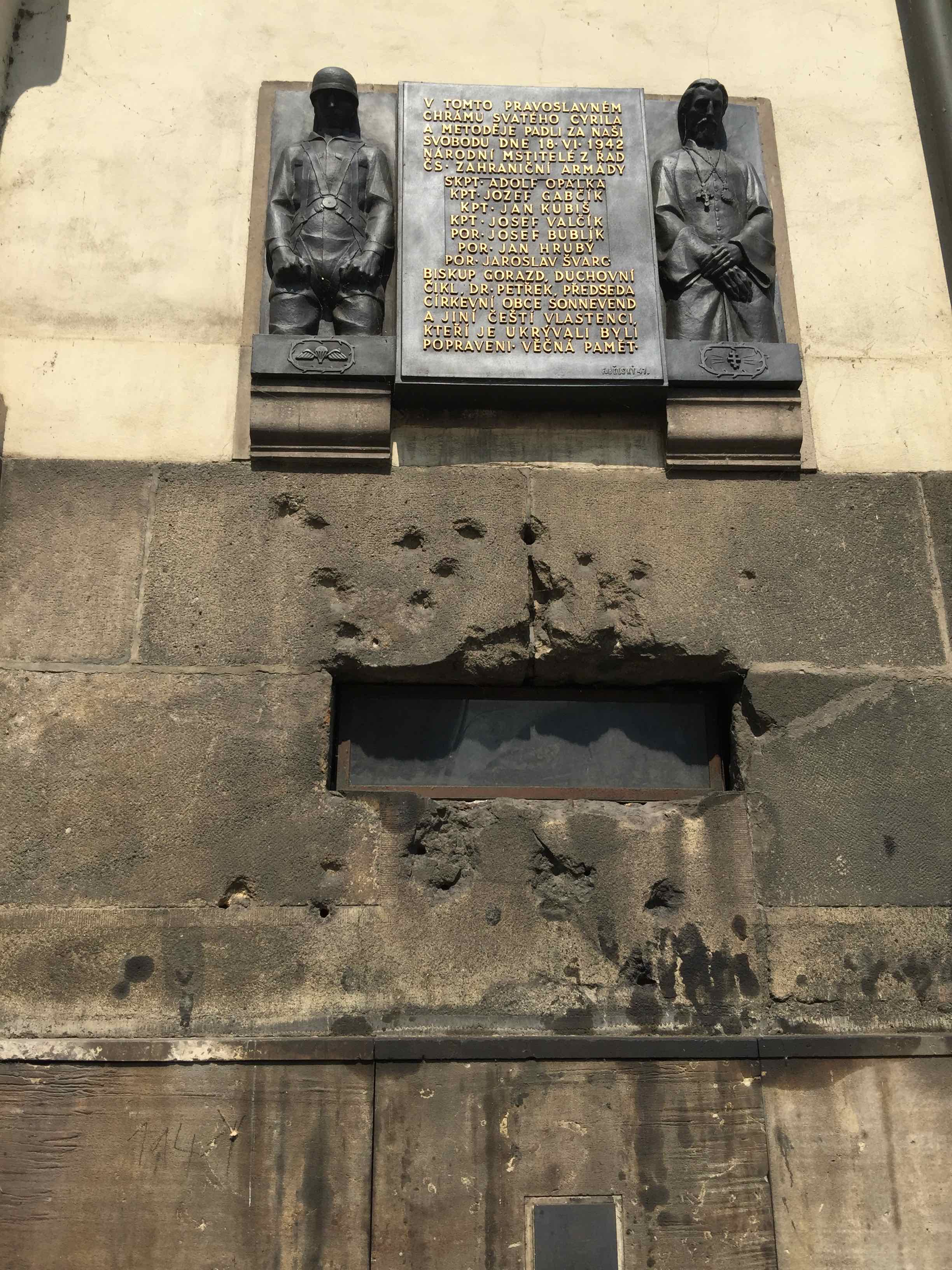
The members of Operation Anthropoid were loyally hid in the church of St Cyril and Methodius in Prague until they were betrayed. Nazis raided the church and three of the seven men were killed in the prayer loft. The other four fled to a crypt below the church. The Nazis opened fire from the outside until they discovered this tiny window that opened into the crypt. The crypt was flooded with tear gas and then with water provided by the Prague Fire Department. The four committed suicide.

Bullet holes from the Nazis
Window where the Nazis used Prague firehoses to flood the crypt

The man who betrayed the members of Operation Anthropoid tried committing suicide, but was ultimately hanged.

Present: You’ll see bullet holes in the wall, shrapnel remains, and what we’re pretty sure were blood stains on the floor and walls. You’ll see evidence that the men, before committing suicide, tried desperately to create another way out. It’s harrowing. For less than the price of a coffee or tea, you can see and feel what the men who rewrote history saw and felt in the moments before they chose their fate.

Inside the National Memorial to the Heroes of the Heydrich Terror

Please click here for directions and hours of operation. It’s about two hours to read the information (in both English and Czech) and move through the crypt. The church was not available to move about inside, but you can peer in through thick clear glass.

Travel Diary: The Adventures of Mailing a Postcard in Dublin

This short story is proof that mundane tasks can turn into an adventure with the proper person. Mailing a postcard is not as easy as it sounds. Dublin is the only place where we found a sign that said post, much like the one below, that directed us into a supermarket.

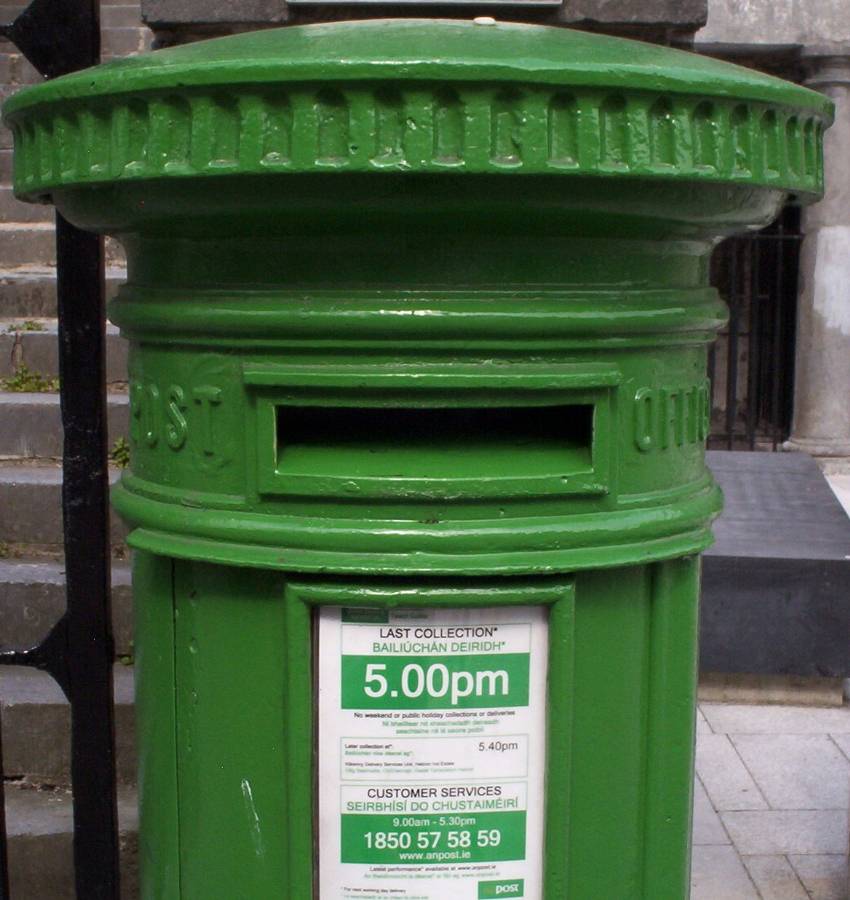
Courtesy of Breaking News, Ireland. Ever so small and kind of easy to miss.

We pass a sign that looks like this and peer in. This is a supermarket; that can’t be right. So we’re walking around South Dublin looking for a post office. A real post office, one that would be green with ample harps and lots of other Irish things. We keep seeing oval green mail drops in the street anxious to receive our mail, but as our postcards do not yet have stamps affixed to them, we can not send them on their merry overseas journey.

Though the post office signs are small, the mail drops are really hard to miss. Daily collection varies from 4:00 to 5:30pm.

After about twenty minutes, we turn around and search again for this tiny sign and go into the supermarket. Everything about this feels odd. We’re in the Donnybrook market, and I see what looks like the beginnings of the warehouse. There are people milling about, so I follow the path all the way to the back of the store. There are those long clear plastic flaps right in front of me, and to the right, I see a two-person queue (that’s a line for my American audiences). Right in this tiny L-shaped, dimly lit area is a post office. There’s two tellers behind bulletproof glass. I go up and ask them for five international stamps, please, which they have to print. She comes back and tells us it’s six euros.

Not a problem, a bargain I think, for such a long journey, and Mark swipes our credit card, which promptly gets declined. The employee sees the error and tells us, debit or cash only. At this point, Mark uses the debit card, and that also gets declined. At this point we didn’t have any cash – so I start to worry. The employee clarifies: “Irish bank cards or cash only.”

Weeeelll, that kind of changes things a bit! We ask where the nearest ATM is, across the street, and walk over only to find out it’s Out of Order. The next ATM is a good ten minutes away, and we have twelve minutes to get our postcards in the mail for the 5:30pm pickup. What a maddening deadline. The next twelve minutes is us running to the ATM, waiting eons to withdraw cash, running back to the post office disguised as a supermarket, waiting in a now very-long queue to pick up our postage stamps that we quickly affix to the postcards and bid them adieu as we drop them promptly at 5:29pm.

Mission. Totally. Accomplished.

Guinness Storehouse Made a Customer out of an Unlikely Guest

If you’re a modest beer fan or with someone who is, the Guinness storehouse is a sensory overload. Six floors of beer and Irish history will fascinate and bewilder you. I wasn’t a fan of Guinness (too dark, too heavy, too bitter) until I took this tour. I’m glad Mark really wanted to go, and in a selfless act of love I went along.

Planning the trip, you’ll do best allowing three hours for it. Stepping into this building is like stepping into a time machine. You’re lost in the process, the maze that is the storehouse, and after enjoying the best Guinness you’ll arguably ever have, you’ll probably not want to leave.

Entry is 10% off if you book online, which we did. I was surprised this isn’t a guided tour. Everything is self guided and at your own pace, which is typically disappointing to me because I remember less if I’m reading it. However, Mark’s wealth of knowledge made it seem like I had one anyway. At one point, he was explaining the process of where the stout goes after its different stages and a small crowd had gathered around him. I was disappointed that an audio tour wasn’t available in English either, but it is for eleven other languages. Complimentary of course.

At the entrance is a piece of paper in the floor with thick glass covering it. That is Arthur Guinness’ 9,000 year lease in the 1750s. Can’t imagine what people are going to make of this note when it expires though.

Barrels of GuinessBarley at GuinessThen the tour begins! There’s a huge area of barley which I could not resist running my hands through and feeling the texture between my fingers. Videos of the barley growing/ collection process play on overhead projectors. There are a LOT of people. I didn’t really grasp why organizations limited the number of visitors to a place until we were in here. The line moves relatively quickly, through the general fermentation process.
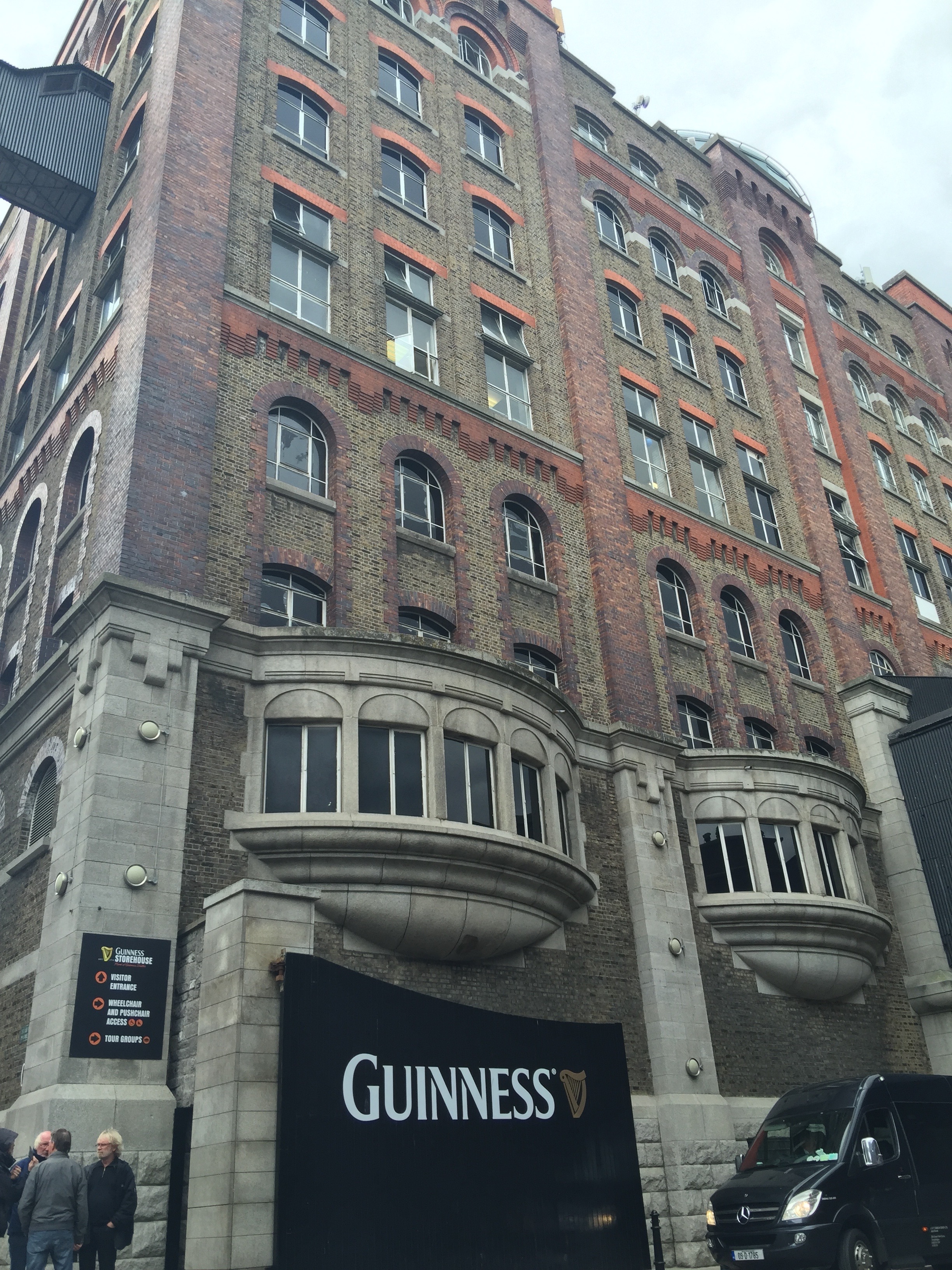
Guiness Storehouse

This storehouse, St James’ Gate, is absolutely enormous – 55 acres of dark, beautiful Guinness-brewing sensationalism. The public is allowed through six floors, but they’re not fooling me – I know there’s much more to this enterprise than Guinness lets on. Over three million pints are made here – DAILY. That’s a modest amount of Guinness, right? Nearly 75% of all of Ireland’s barley goes to making this iconic stout – the most popular in the world, in fact.

It could be a little bit of madness, but I swore up and down I would never enjoy a Guinness, and yet here I found myself, next to Mark, enjoying a properly poured Guinness at the ever-impressive yet crowded Skybar.Guiness at Skybar

Expectation v. Reality: Reflections on the UK, Ireland, Belgium and Norway

This four part series is a compilation of something both memorable and shocking for each of the countries we have visited. Alas, the first of an ever evolving set of self-reflective, preparation posts for the questions that I’ll inevitably get when I return home:

“What’s changed?” and “Do you feel any different?”

And I’m reminded of a quote by C.S. Lewis: Day to day, nothing seems different, until one day you look back and find that everything has changed.

This is more a fun, haphazard collection of preconceived ideas, romantic fantasies and expectations of easy living I had before and during the visits to the following countries, along with their earth-shattering thought replacements:

  1. There are absolutely zero downfalls of public transportation! – England

Or so I said, before visiting London, which is really a country in itself. Not only does it get uber smelly on the underground, which is always busy, even at 1pm on a Wednesday, but tube strikes are not uncommon. Have you ever been to London when there’s a tube strike going on? The giant sidewalks aren’t big enough for the throngs of people waiting for the buses that are already full of smelly people nor are the roads able to afford anyone unlucky enough to be driving a car during a tube strike any traveling space. The tube strike that happened in July cost London nearly $500 million.

New thought: Sometimes, public transportation and the throngs of people in your personal space actually really sucks.

  1. Every capital city is worth going to. – Norway

Norway, for at least one year out of the past five, was the most expensive country on the planet. And we were warned that Oslo is perhaps the most underwhelming capital city Europe has to offer (We’ve since found one worse). Go to Norway? Yes. Go to Oslo? Hell no. Save yourself. Go anywhere else in Norway. Don’t go to Oslo.

Pub dinner: $110
Oslo’s version of Chipotle: $38

How can I eat my way through culture when every time I take a bite money actually ejects itself from my wallet and self-destructs?

Please don’t visit Oslo. Seriously.

New thought: After a dozen or so capital cities, they all really look the same. Fly into a capital city, and establish an adventure base elsewhere.

  1. The United Kingdom totally drives in kilometers per hour just like the rest of the continent. – Scotland

One of those situations where I would have bet money that I was right and I would have lost the bet. Funny story, abridged:

We rented a car in Edinburgh and got on the motorway (highway for us Americans) and came to a sign that says 70, so we do 70 kph. We approach signs telling us speed cameras. Other cars flash high-beams and swerve around us. We think all those people are stupid and are all getting speeding tickets. Next day, we confirm Mark’s suspicion. The UK drives in MPH, not KPH. The clincher? Distance is measured in meters, as in, “Hotel, 800 meters ahead.” Way to be confusing, Britain.

New thought: UK (and Ireland) drive on the left. Rest of Europe, on the right.

  1. Ireland is the place to get drunk on the cheap.

With the reputation that Ireland has of being a nation in perpetual drunkenness, I definitely thought that it would be ridiculously cheap to drink here – say 2 or 3 euros for a beer.

Color me surprised, it’s not.

It’s about 5 or 6 euros for a beer, and more in the touristy Temple Bar area, which is definitely not acceptable for drinking on a budget.

The tour of the Guinness Storehouse did shine a bit of light on a Guinness pour: if you get your stout less than two minutes after you requested it, the bartender poured it wrong. There’s mad science behind all of this which Mark is slated to explain.

New thought: Get drunk in Prague. Cheaper and more interesting a crowd.

  1. Living above restaurants is awesome and I want to have the life Marshall & Lily have. – Belgium

Wow, I was dead wrong on this. We stayed at an Airbnb that was up 8 very dark flights of stairs. The building apparently had no lights. The entrance opened up into the street with a restaurant to the left and to the right. I’m not a morning person, and I am very used to a long wake-up period. Not so in Brussels. As soon as we opened the door people were milling about in front of it from dawn to the middle of the night. After our evening meal and drinks, near the wee hours of the morning, we had to push people out of the way to get to the front door. Once we traipsed up eight flights of stairs in total darkness, we thought we’d be in the zone to sleep, but we couldn’t, because it was so dreadfully hot we had to leave the windows open and thus gave us an earful of the drunken commotion happening below.

New Thought: Overhearing yelling, screaming, fighting and crying until 3 or 4 in the morning is definitely not my idea of a good time or a good stay.

Have you been to any of these places? What were your experiences? Send us a shout in the comments below.

Ciao

Connecting Flights in Istanbul Means No Visa Required

There’s mixed information about whether a visa is needed for Americans and Canadians to connect flights at Istanbul and since we experienced it this morning we’re letting you know now you do NOT need a visa if you are connecting flights so long as you…

do NOT go through passport control. A lot like Monopoly. Do not pass go. Do not collect $200. Do not follow the signs for passport. Instead, merge into the long queue (line) where it says INTERNATIONAL TRANSFERS. You will go through security, again. 

It’s a trend in “Europe” that you will not see a gate assignment more than two hours before your departure time. Once you clear security, you fall into the absolute madness that is Ataturk airport. People swarming, dozens of languages and dialects, exclamations, babies crying, people laughing, tourists touristing… This airport is something else. I’ve never seen such a cosmopolitan sample of people. Every face a different ethnicity. I found myself invigorated. Like all of the world came to meet here at Ataturk airport.

If you arrive more than two hours early, you won’t have a gate, but there’s no shortage of things to do. You can people watch. Most people sleep. Turkish airlines is notorious for taking off at 3 or 4 in the morning.

And that’s it! We were really happy to find a Costa coffee and a long row of chairs where we plopped down and passed out for 5 hours.

Once you awake, CHECK THE SCREENS because there’s a good chance your gate has changed. They shuffle planes here more frequently than a poker dealer shuffles cards. Mark had his wits about him and discovered our plane had parked ten gates away so we did a little bit of running ourselves to get through the tide of people.

If you have a layover longer than five hours, there’s a tour group that will give you an abbreviated tour of Istanbul. If you DO want to do this or you want to explore Istanbul on your own, you will  need to get an e-visa at the airport. Continue reading here.

Mark and Melody

24 Hours In: Things We Learned in Copenhagen

Actually, things we wished we knew.

Note: Nudity and questionable language.

1: That our hotel had complimentary shuttle service to AND from the airport, so we didn’t need to spend $40 for two tourist transport tickets.

2: Google maps is as helpful as a foreigner giving you directions in a foreign language. It doesn’t have the correct coordinates for the free walking tour- not even close. It also incorrectly estimates travel time between destinations. This is the second time it has lied to us.  Think it has a bone to pick with free walking tours.

3: If you’re looking to go to Malmö, Sweden, because you also love the idea of lunch in one country and dinner in another, the last bus BACK to Denmark leaves at 6pm. Color us disappointed. Also, that ticket there and back is 100 Danish Kroners (DKK).

4: Don’t tip here. They make enough money, honestly. And there’s a service fee included basically everywhere anyway.

5: I wish we knew about the lack of authentic food. Totally disappointed by the mass Americanism and English speakers/ signage everywhere. It just felt too close to home. Not exotic enough. Perhaps we’re a bit jaded from Finland. We felt cheated, culturally. Remember how I was lamenting the absence of fried chicken and peanut butter? Both of these are here. I don’t even know what Danish food actually is. Where is it? I had a croissant with jelly in the middle. I was told that’s a Danish. They say a good measure of a city is by its food: I’m underwhelmed by a KFC and a two story Burger King. /rant

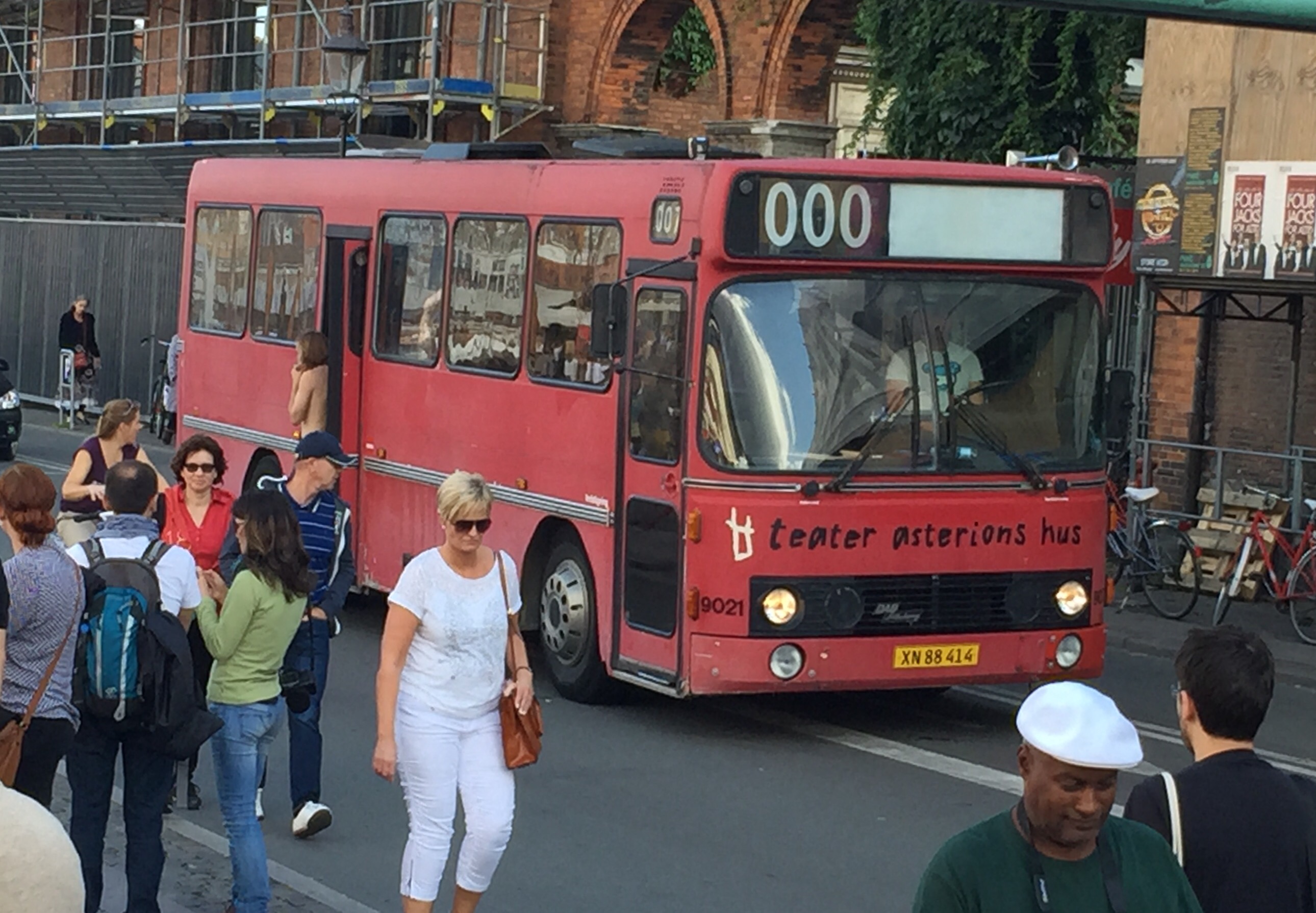
6:  Public nudity is acceptable, maybe as a spectacle but even still. Sitting in the über touristy part of Nyhavn and this (drunk) guy runs out of a party bus and swan dives into the canal. Cool right? I thought so. Then dude reappears, totally naked, runs through a crowd and jumps into the water again. People start half clapping, mostly staring, some laughing. Dude gets out of the water and just kinda walks back to the bus with his bros slapping his ass and grabbing his balls. Maybe a bachelor party? Can’t tell. That’s Copenhagen for you.

The bus in question. Feast your eyes on the naked man off the side.

7 Golden Rules to Surviving the Colosseum

In a universe far, far away, the Colosseum isn’t a hive swarming of tourists without deodorant. It isn’t in an awkward stage of half renovation where one side of the amphitheater looks completely fake and the other is a historic wonder of the world.

Unfortunately, we don’t live in that universe. I’d love to visit the Colosseum in those circumstances. Begrudgingly sometimes I go to such iconic places because it seems to make every life that visits it so. much. better.

The Colosseum is impressive. It is worth visiting. Because I know you’re going to go, here’s seven survival tips to make it much more enjoyable.

7. If you’re going between April and October, go to your Dollar Store/ Poundland and buy handheld fans. 

Otherwise you’ll melt. Honestly. Imagine a human current that takes you to different places and you’re shuffling along (and not in the cool way). There’s no way to not sweat. Bring a handheld fan and not only do you get to keep cool but you also get to accidentally hit stupid people that intentionally block your photo.

6. Toilet before you walk.

Toilets are by the audioguide pickup which is really inconvenient to get to once you’ve started walking around, that is. You have to walk downstairs (or through a hallway) and then you have to shuffle and scoot past the people that are trying to enter and shuffle and scowl at the people crowded around the audioguide pickup because the concept of a queue is lost here.

5. BYOB. Water bottles, that is.

I did mention it gets atrociously hot. Put some water bottles in the freezer and take them with you in your satchel/ man purse/ backpack and by the time you get into the Colosseum you’ll have about half a bottle of water to drink.

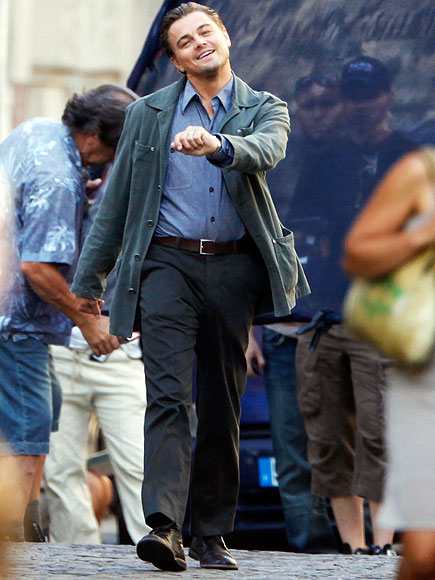
4. Buy your tickets here. Don’t be a dimwit and think you want to buy them at the door. Breezing past all of those people makes you feel like:

happy leo

And who doesn’t want to feel like that?

3. Pack a 4-liter bottle of patience. Or maybe just bring a flask to tolerate the very annoying groups.

You know, the kind that everyone loves that amass a group of about 20-30 people and then STOP RIGHT IN THE MIDDLE OF THE WALKWAY AND DECIDE TO GIVE A TEN MINUTE DISSERTATION ABOUT BRICKS.

2. Go to this restaurant to escape the crowds and the heat. 

Lovely, jovial older Italian gentleman who cracks jokes and has a sweet smile. They have little croissants for 3 euro and some really good espresso and Mark ordered lasagna which was divine and then some. Oh and for all my fellow AC-loving Americans, they have real air conditioning!

1. Get up at 7am and take the first uber there around 8am. 

Thank God Uber is here! The Colosseum is worth losing sleep to get even an hour without the droning and humming of the mid-morning tourists.

If you would like a quick look at the interior, from our perspective while we visited, see below!

Ciao, beautiful people.

It’s Okay! You Can Skip the Vatican Museum and the Sistine Chapel

I can’t believe there’s not more blogs promoting this. I really don’t understand why it’s on so many people’s life goals lists (Please tell me in the comments). It’s like millions of people suddenly become devoutly Roman Catholic and suddenly care about the lineages of the popes, what the popes wore, what they did and didn’t do, who they did and didn’t kill, and an even greater number of people pretend to really, really like art.

If you’re not on a pilgrimage to fulfill a religious preoccupation, you can skip the Vatican Museums and the Sistine Chapel for any of the following reasons:

It’s expensive

16 euro if you dare wait in the queue (are you insane?) or 20 per person if you pay online. It’s a 4 euro convenience fee to pay online. You still have to stand in a line to pickup your tickets from the ticket counter. Then you shuffle.

Shuffle, shuffle, shuffle.

And sweat, sweat, sweat. This is Italy which means there’s no AC in this building. It’s very old and AC is new. I’m not sure where the 4 euro fee is going, but it’s not going into cooling the building where the average number of visitors is more than 15,000 a day. This isn’t an area with wide walkways or an air current or even somewhere to stand off to the side. Throughout the entire walk through the museum, shuffle shuffle shuffle, which reminds me, I can remember taking exactly six real steps. There’s nowhere to really admire artwork, so actually,

It’s visual overload. 

Every room is ornately painted or carved from baseboards across the ceiling. EVERY. ROOM. You begin walking and trying to take in the beauty and enormity of the artwork, but you can’t because these IDIOT GUIDES and their flock of 20-30 something tourists walk right in front of people that are clearly trying to take a picture or admire artwork. You ask them, mi scusi, a photo? and you get the most disgusted look and a 15% chance of someone actually moving. Two hours later, by the time you get to the Sistine Chapel, you are so tired of seeing 16th century art that your eyes kind of glaze over and Michelangelo’s famous painting The Creation of Adam, becomes an actual snoozefest. Speaking of Michelangelo…

The Sistine Chapel is last room of the entire museum. 

And you’re supposed to be silent. All the signs before you enter tell you to 1) cover your shoulders, 2) cover up your super cute mini, AND BE QUIET. “Silence” is universal. But thousands and thousands of morons can’t keep their mouths shut and they keep whispering. So the guards shout SHHHHHHH! across the chapel and people think it’s funny so they keep talking. Again, you shuffle, and the museum guards make you shuffle in a particular direction. If you don’t shuffle that way you’ll be forced that way. Shuffle shuffle. All the sitting room will be taken, so you stand in a crowd of people that are smelly and sweaty and you just stare at the ceiling. No point in taking a photo. The ceiling is so tall you can’t zoom in far enough with any camera to get a fair picture of Adam and God. Speaking of which..

Take a picture of the Sistine Chapel and be prepared to get thrown out.

No one ever said #ShamelessSelfie with Michelangelo is a good idea. Signs have a picture of a camera with a line through it. No photo. And what do these idiots do? Hold their camera up above their head and try to take a picture, then act all surprised when they’re approached by a guard. Are you serious? How daft do you have to be?!

After you finish the Sistine Chapel, you’re guided through the histories of each Pope, what they did wrong and what they did right (all in Italian of course). At this point you’re just ready to leave. You came, you saw, you pretended to be Catholic or you pretended to know who Raphael was, and then you leave.

Want to have a good time at the Vatican? Don’t go. Just don’t. 95% of the people who go there are better off somewhere else.

If you insist on going, here’s my sage advice:

  • Buy the ticket online and deal with the 4 euro/pp convenience fee.
  • Enter the “group with reservations” line.
  • Go through security, put your bag on the line, and go straight to the left where it says tickets.
  • Show the wo/man your phone, get your tickets printed out.
  • GO UP THE RAMP. Do you really want to be stuck with a bunch of smellies on the escalator? No, you don’t.
  • Finally, at least pretend to be interested in something other than the Sistine Chapel, and divert if only for a moment to another room. We enjoyed the “Modern” Gallery right before the SC entrance.

Ciao.

24 Hours In: Surprised and Culture Shocked in Naples, Italy

Italy marks country number 14 and I may be speaking for myself but I am currently experiencing a severe culture shock. English is not widely spoken (it wasn’t in Finland, either), the four-hour breaks in the middle of the day are NOT a joke, and the laws of driving, walking and living are merely suggestion. Here’s a list of observations after 24 hours that have been doubly frustrating for us, so hopefully you come away from this read more enlightened with a better chance of enjoying your time.

Dining

It’s extremely difficult to find someone that is willing to speak English out the gate. It seems that most people want you to fail at Italian so they can get a good laugh before they attempt to help you. Once you sit down, it’s a 1 euro fee (per person) to occupy the space. At a higher end restaurant, this can be up to 2 euro. It seems through experience that you’re expected to know what you like to eat straight away, and order drinks and food at once. At one restaurant, we were told to reuse our water glasses for the wine because it’s “tradition” to drink wine and water from the same glass (Can anyone actually confirm this?).

Once you order, expect to never see your waiter again. American expectations of hospitality: How are you doing? Do you need anything else? How is the food/ drink? are completely absent. Let me say it again. You will not have a waiter come by and ask you if you need anything else. EVER. I read in an Italian culture blog that their perspective is to leave you alone until you need something; however, this is only really effective if you can actually find a waiter to flag down.

You eat, you drink. Every restaurant we’ve visited sets bread on the table. If you eat the bread, it’s another charge of 1 euro per person.

Then you receive the check. There was a bill yesterday that literally read: Pizza, 50. Pizza, 8. The total was 58 euros. Every restaurant must provide an itemization of what you ordered. Demand it if they don’t. In our case, we asked for it because all we wanted to see is that the waiter understood our order. Turns out he was right, but I was charged an additional 2.5 euro because I wanted my chicken grilled, not fried. 😦 

Activities and Things to Do

Sunday: Only a few restaurants open after 2pm. Some stores open. Not much. I was told bars started opening up after 8pm. Supermarkets and grocery stores also closed on Sunday. If you want to do anything in Naples, don’t arrive on a Sunday.

Monday: Actually, don’t arrive on a Monday, either. Apparently there’s NOTHING open on Monday. If you want to visit the Naples National Archaeological Museum, it’s closed. Want to check out the Bourbon Tunnel? Closed. Want to understand the history of the Catacombe di San Gennaro? Closed. Want to unfold the history of LAES – La Napoli Sotteranea? Color me surprised – that’s closed as well. Turns out that reviews on TripAdvisor are useless if you plan on visiting anything of merit on a Monday.

Tuesday: If you’re dead-set on taking a day-tour to Pompeii, Herculaneum, or Mount Vesuvius, odds are you’ve checked out the tours offered by Viator. Turns out they run tours every day except for Tuesday. That’s the day we wanted to go. Need to go to Pompeii, Herculaneum or Vesuvius anyway? Your best bet is to rent a car from the Napoli train station and hope for the best while you drive yourself. Haven’t done this yet – will report on it after 9th September.

**NOTE** Booking tickets to Pompeii online so you can go it on your own? You can only do so if you have an Italian address and an Italian equivalent of a social security number. Not Italian? Sucks to be you (and us) – you’ll be lining up at Pompeii to get your ticket at the door.**

Wednesday – Saturday: All I can say is that from about 12:00pm – 4:00pm, it’s slim pickings for food, cappucino, or a glass of wine. We’ve been here for nearly a week and still haven’t adapted to the 4 hour absence of food that isn’t gelato or espresso or pizza.

 Accommodations

Our Airbnb has been good to us so far. Space is so limited here that there isn’t even a place to put a clothes drying rack on the balcony. You have to let it fly freely in the space away from your balcony. No big, right? Until one of your clothing items falls down to the concrete overhang on the ground floor. No worries, says Mark, I’ll go get it. So he walks down to the ground floor, braces himself against the CONCRETE OF THE OVERHANG, and guess what? The concrete holding up the building actually COLLAPSES. It collapses. Are you kidding me? Not to mention Mark free-falls 7 feet and now has a lovely bleeding gash about 2 inches across. Also, if the place has an elevator be prepared for world’s smallest. It fits two people and two carry-on bags. That’s it.

Lifestyle

Drivers in both scooters and cars will run you off the road. They run the show. Pedestrian right of way? That’s funny! Smokers (of real cigars and cigarettes) abound and they have no problem letting you know about it on the exhale. Train rides, unlike Germany, the United Kingdom, Italy, Finland, Brussels, the Czech Republic, or France, are ridden with conversation and children yelling and running up and down the aisles of the train. If the quiet, near-silence on the trains in other parts of Europe gives you anxiety, don’t worry, because that quiet won’t exist here.

NOTE: There was also a protest today. Apparently the Napoli mayor is really sticking it to the Prime Minister. It was a peaceful demonstration that lasted about 6 hours with some rhetoric sprinkled in.

—-

That’s Naples after 24 hours. Tomorrow we’re picking up a car and driving ourselves to Pompeii. Taking adventure to an entire new level.

Ciao.

Special Report: Teaching at a Finnish School

Note: Special interest piece about an educator and her humorous first experience teaching abroad. Not at all travel related.

There’s a saying: “Good things happen one at a time. Great things happen all at once.” In two days’ time, I completed my TEFL course and taught (albeit briefly!) a grade 3 class of Finnish elementary students on their second week of English. Initially, my visit to the school was just to observe how an English class was taught. It’s one thing to read a ‘how-to’, and another to do it, right? Well the teacher, being shy and nervous that I would be judging her English abilities, decided I should give a lesson as well!

Enter nervousness. I hadn’t quite pictured my coursework being so relevant so soon! But at the same time, I was enthralled to teach these kids anything.

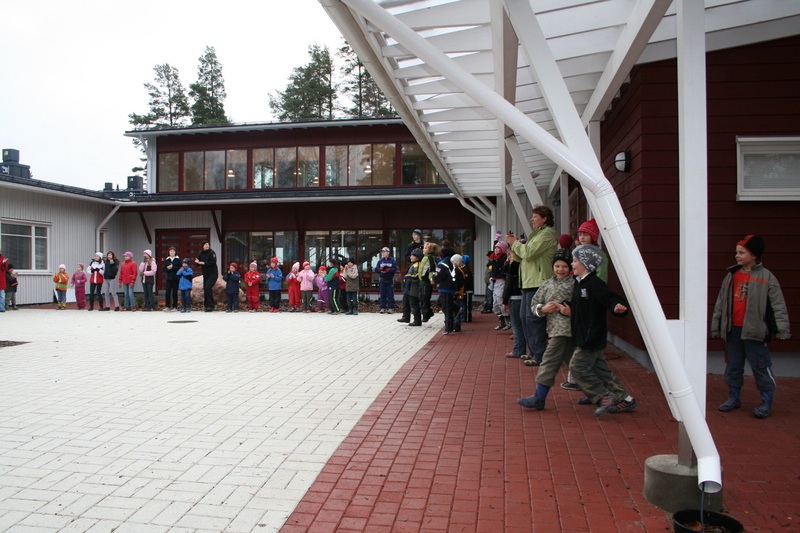
I’m driven by my lovely Finnish host, who’s like a second mom, to the school. It’s modern yet rustic. Kids are out in the courtyard, running around, laughing, smiling. They still take recess here. Tall glass windows dot the building. It’s a cozy school.

grounds
Courtyard of the school. Courtesy of the school’s website

I’m greeted immediately by the English teacher, who is wide-eyed and happy to see me. We exchange greetings and two girls approach us. The teacher speaks in Finnish to them, then tells me they will be giving me a tour of the school. Oh how cute!  I coo. They lead me inside and there’s a foyer with shelves of names.

Then they slide off their shoes and motion for me to do the same.

In Finland (and nearly everywhere else in Scandinavia, I’m told), it’s customary to remove shoes before entering a building. Avoid tracking in dirt, mud, snow, and anything else from outside, right? Keeps the buildings cleaner and the adults (more) sane. I remove my shoes, and then it occurs to me that all of the classes are done in socks. Or barefoot. Whatever the kids wear to school that day, they go to class sans shoes.

The two elementary girls give me a tour in English, of the school. It’s laid out like a U, with classrooms on each side and the cafeteria in the middle. Each grade has its own classroom of no more than 16 students. There is also have a music room and a woodworking shop. Students begin woodworking in grade 3; they make top-open boxes, periscopes, and wooden art that is painted and displayed. if they don’t want to do that, they can practice textiles.

Adorned in fuzzy and colorful socks, we walk back to the English classroom where the 45 minute class just began. I sit at the back of the class, and had I not already seen these kids at a birthday party, I would have been incredibly interesting. The teacher instructs in Finnish, tells the students to open the textbooks and they begin counting numbers 1-10 in English. The teacher says ‘One’, the students wait, and then say ‘One.’ So it continues until they reach ten. After a couple repetitions, though, students get excited and begin counting ahead of everyone else. They break up into pairs of two: one student knocks on the desk and the other student counts how many knocks. This lasts about five minutes, so they move to a song about bananas, which seems to engage only a few students. Then I hear quick Finnish and my name.

Melody. Some laughter. Melody. There it is again. Oh, she is talking about me.

The teacher asks me to come up to the front of the class as I am going to give a lesson!

I walk up look at this beautiful energetic bundle of students. Oh, I wish I had something brilliant for them! Then the teacher asks them to go one-by-one, say “My name is..and I like…ice cream.” After they do this I feel infinitely relieved.

And then I have an idea: let’s play Red Rover!

I tell the teacher the gist and we head outside. The kids are over the moon excited. Anything outside is better than a classroom, right? Now there’s the issue. The teacher is by no means fluent in English. It’s okay for third graders, but this is better shown than explained. So I split the group into two sides.

7 students with me, 8 students with her. My group stays on one side of the field and the teacher’s group opposite us.

I don’t know if you’ve ever had to communicate with someone who doesn’t know ANY of your language, but demonstration is probably the most entertaining. I hold a girl’s hand, and I hold up our joined hands and point to her and the next girl’s hand. They start laughing, but it works. Children are amazing copycats. Soon we have a hand-holding line. The group across from us sees what we’re doing and quickly follows suit.

Now I sing the song: Red Rover, Red Rover, Come on..over!

And I demonstrate running toward the line and breaking the human chain and if I break the chain I become part of it.

It occurs to me now that when I break the chain I’m supposed to bring someone back with me to my line. Ughhhhh! Must know for next time!

We go back and forth with this for maybe 30 minutes. I see smiling faces, running kids, and every other turn, I make them count as we lose and gain people.

One, two, three, four…eight, nine, ten!  One, two, three…six, seven!

Over and over again. They’re counting. I ask “How many people?” And they count. Over and over. I feel like they’re more comfortable using the words.

The class-time ends much sooner than I wanted to, and in one final motion we all run toward the group opposite us. This becomes a running fest. A girl tags me, like ‘Tag, you’re it!’ So I begin chasing after her with Jim Carrey’s “The Claw!” from Liar Liar.

Liar-Claw

These kids think it’s hilarious. Three more kids join in, tagging me and activating The Claw. Two more kids join in, and then I make The Claw break down, and I turn into a zombie chasing them about the courtyard and then they shuffled them back into school for their next class.

Moral of the story? Best day ever. And nothing can stop The Claw.

Travel Diary: An Adventurous Self-Drive into the Scottish Highlands

Exploring the Highlands, if only for a day, is a must for any itinerary to Scotland. Deceivingly, they look much closer than they actually are. This is because in order for the Highlands to be Highlands, they have to be mountainous, rugged terrain, that’s what makes them Highlands. Navigating a road on this terrain is no small matter, and neither is driving on it.

Most people opt for the road-more-traveled: a day trip in a coach where you are comfortable and a driver takes you right to the scenic area, you take a dozen snapshots and return to your home, satisfied.

That’s not how we travel. We like to do things on our own.

I would have loved to do this drive by myself except manual transmissions and I don’t always get along. In some cars, like Hondas, it’s pretty easy to figure out how to drive. But the car we had wasn’t a Honda. It was a manual transmission car on the opposite side of the road with the driver’s seat where the passenger seat usually is. So Mark had to do the driving. All six hours of it.

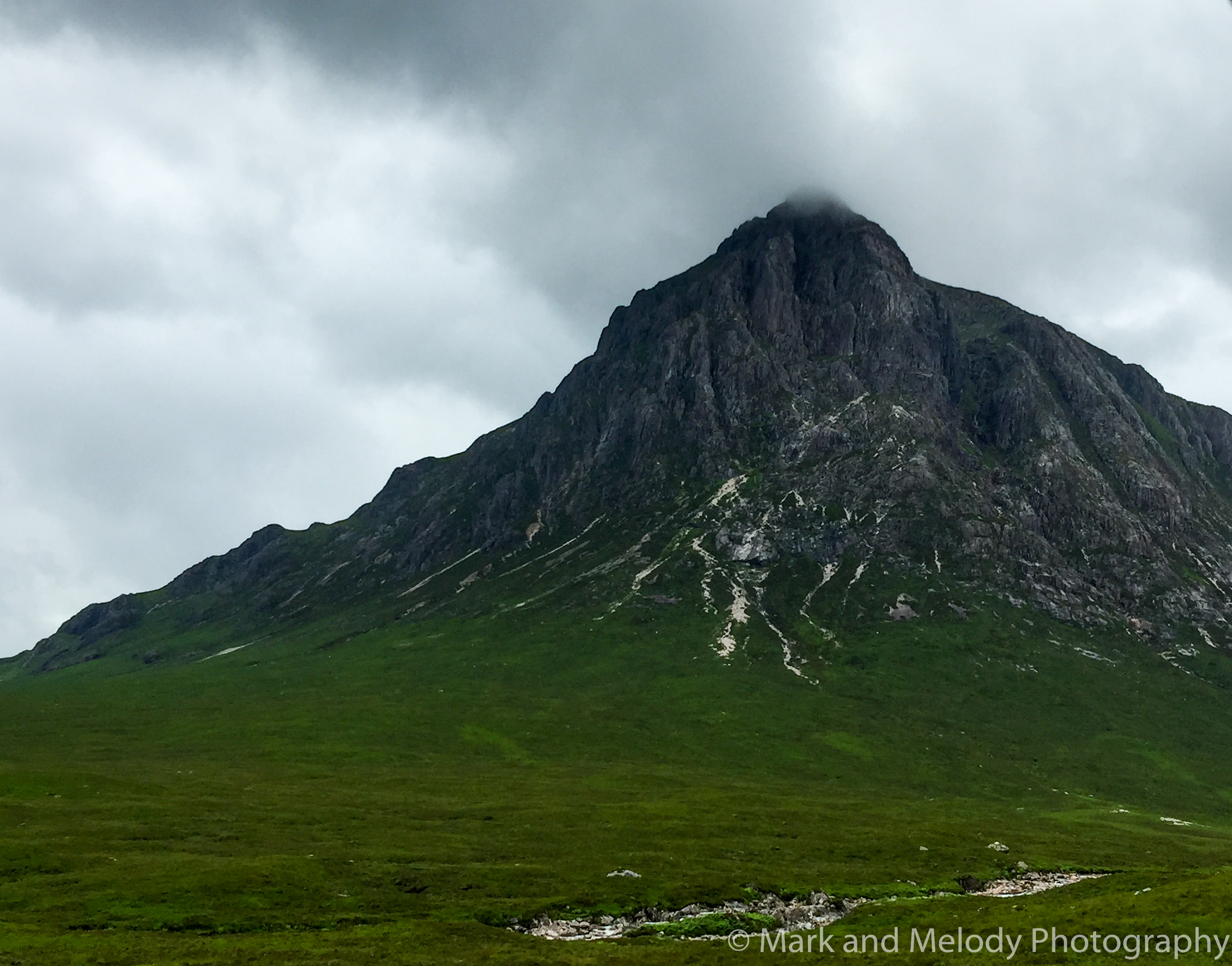
If you’re in Glasgow and you want to get a taste of the Highlands, go to Glencoe. You don’t need to drive to Inverness or even Cairngorns National Park, though both of those are beautiful beyond belief and you could spend a week in either location.

Glencoe is a good introduction to the Highlands that will leave you salivating for more.

Getting through and out of Glasgow is a pretty boring, but once you leave the area, the road starts winding and taking sharp turns, twisting and the roads are narrow. Not just American narrow, but barely enough to fit two cars around the corner. There’s no room for error. It’s difficult to shift, keep your eyes on the road, and take a sip of water, so for the driver, it’s generally a stressful drive. About 40 minutes north of Glasgow, we lost cell phone service and entered Loch Lomond.

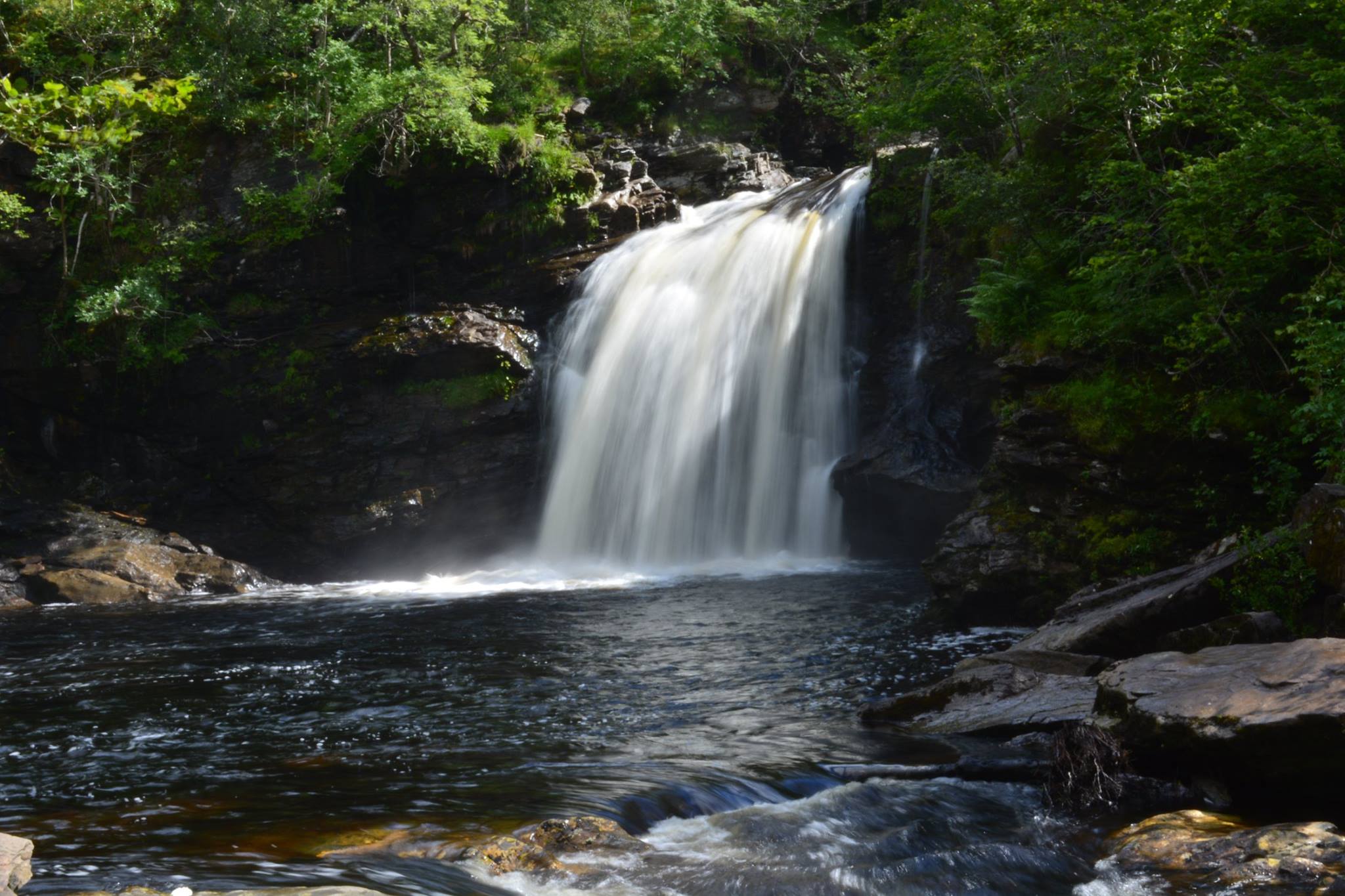
One of the things we look for is a waterfall. Whenever we land in a new place, we immediately go on a waterfall hunt. We heard that a waterfall existed in Loch Lomond National Park (Which you have to drive through to get to Glencoe) but we weren’t really optimistic about spotting it since there were no exits off of the road. However, a lovely, poorly marked sign indicated a parking area for us to pulll off. We did, if for nothing else than to take a quick hike down to the river and take in some of the gorgeous scenery. What we found was Falls of Falloch, a lovely waterfall hidden nested back at the end of a moderate hike.

Falloch Falls
Falls of Falloch

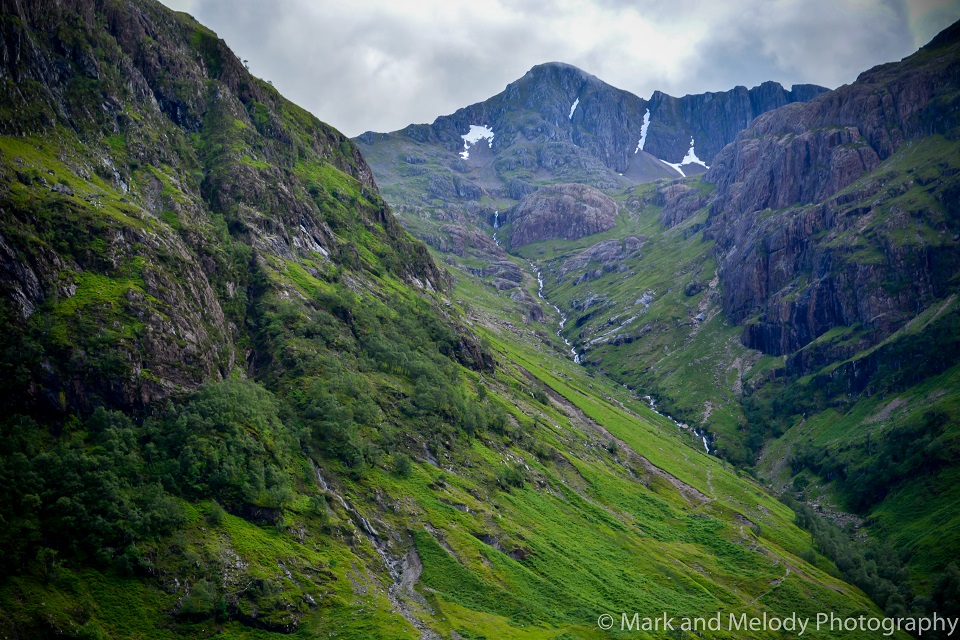
Once we got out Loch Lomond, the scenery becomes much more dramatic and more beautiful.

Entering Glencoe
Entering Glencoe

The problem with doing a self-drive in Scotland is there is virtually no where to stop for a picture. Miles and miles of breathtaking, jaw-dropping lush green and towering waterfalls and there is nothing to travel on but this narrow two-lane road.

So when we finally saw a parking lot to stop, we slammed on our brakes for it. We missed it and decided to pull off on the side of the road, as it appeared to have a shoulder. We do not recommend doing this. Once we pulled over, the rocky terrain grabbed the tires and cut them to the left. The car sank into the mud. The entire left side of the car was in the mud. Tires spinning, clutch burning. I was definitely convinced we were stuck. We were hungry. Gas was nearly empty. It seemed like the beginning to a Stephen King novel. I tried to lift the car out of the mud (most European cars can be lifted by a person of moderate strength), but I couldn’t get a grip on what needed to be lifted up. So Mark trusts me to operate a left-hand drive car while he lifts the car up and out of the goo and…well, forty minutes later, we were back on the road.

Hellooo, Glencoe!
Hellooo, Glencoe!

Extraordinary right? I couldn’t get enough of it.

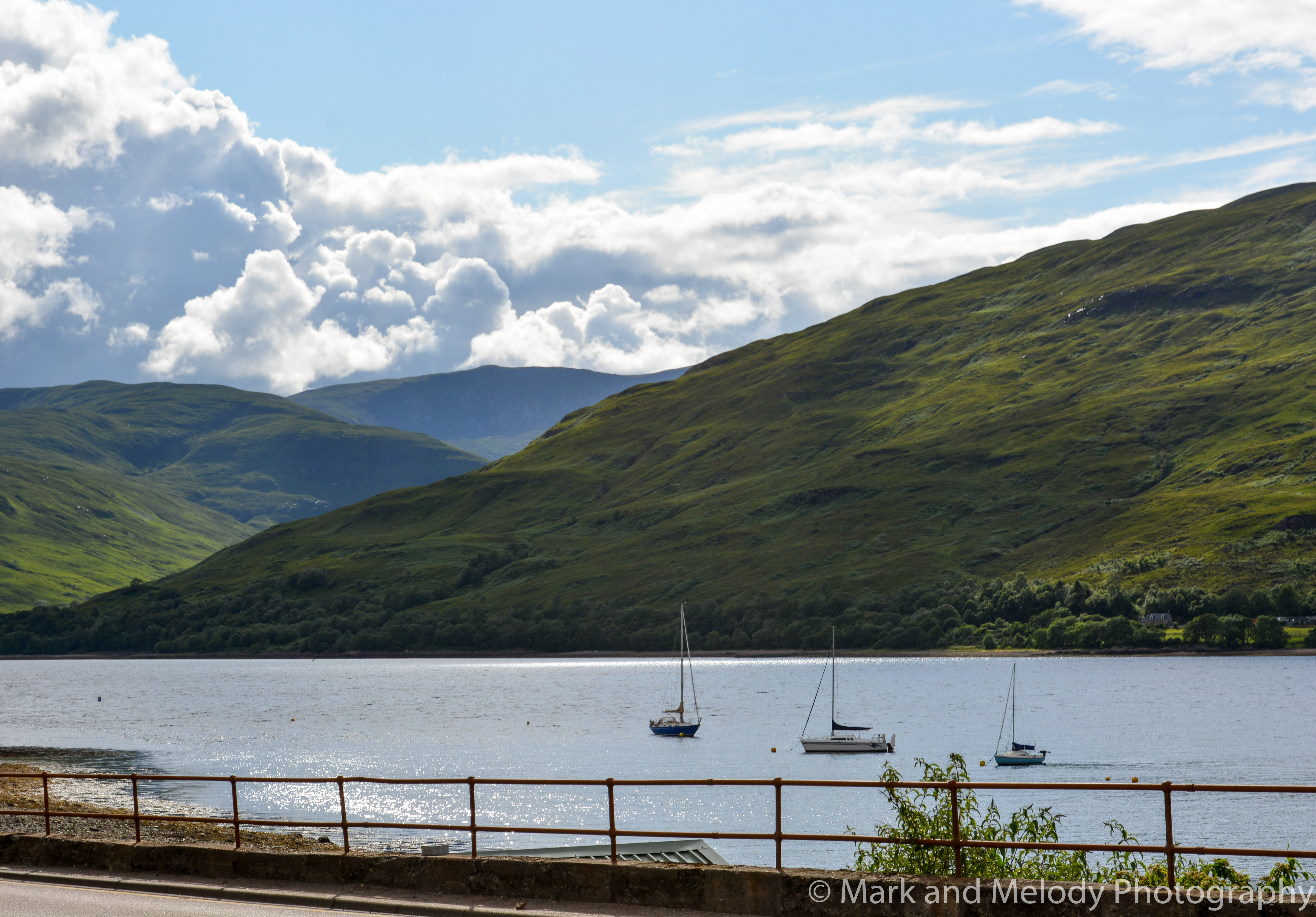
Another couple of hours later, we arrived into Fort William. I expected more of a town than It actually is, but on one side of the road is a row of bed and breakfasts, and on the other is a beautiful lake and mountains.

Fort William, where you want to stay if you're to explore all of Glen Nevis
Fort William, where you want to stay if you’re to explore all of Glen Nevis

We are looking for a place to stay, or get information, but things aren’t very well marked out. Apple Maps finally makes a comeback, as we haven’t had map service since Glasgow. What a relief. I find the tourist information center and the woman there recommends a park called Glen Nevis. Says it has some waterfalls and a few nice hikes, best part of everything? It’s free! Off we go to Glen Nevis.

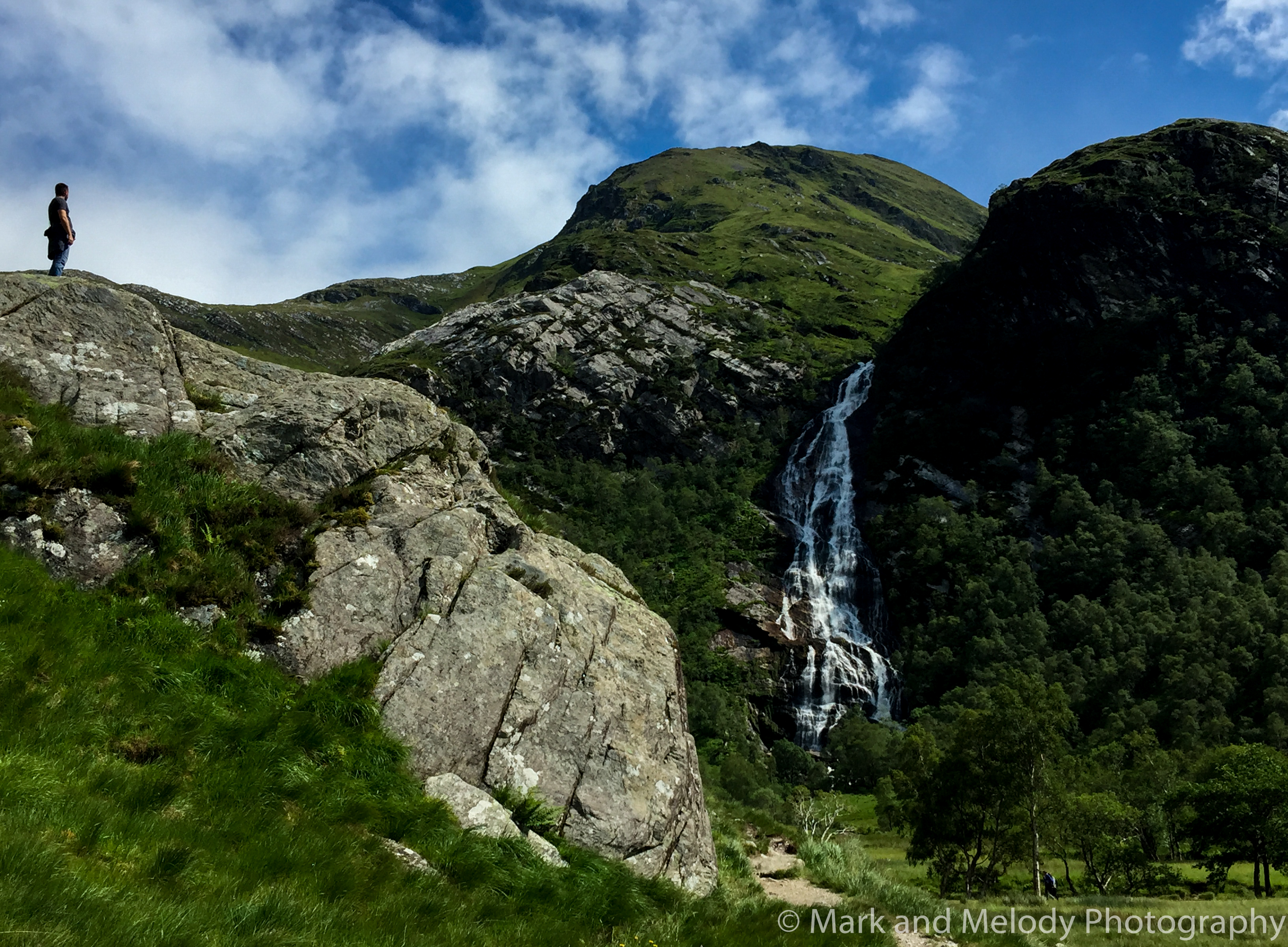
Glen Nevis really is like walking into the wilderness of the Highlands. It’s one-way dirt roads with pullouts to let the other cars pass by. We drive 7 miles on this narrow, gritty dirty road all the way to the end and get out. There’s one waterfall at the end of the trail so we follow it. The trail starts out pretty easy but gets pretty dramatic. Water trickles over exposed rocks and the air begins to thin. Elevation gains are made quickly but the scenery is breathtaking. Strongly recommend hiking boots or strong sturdy hiking shoes.

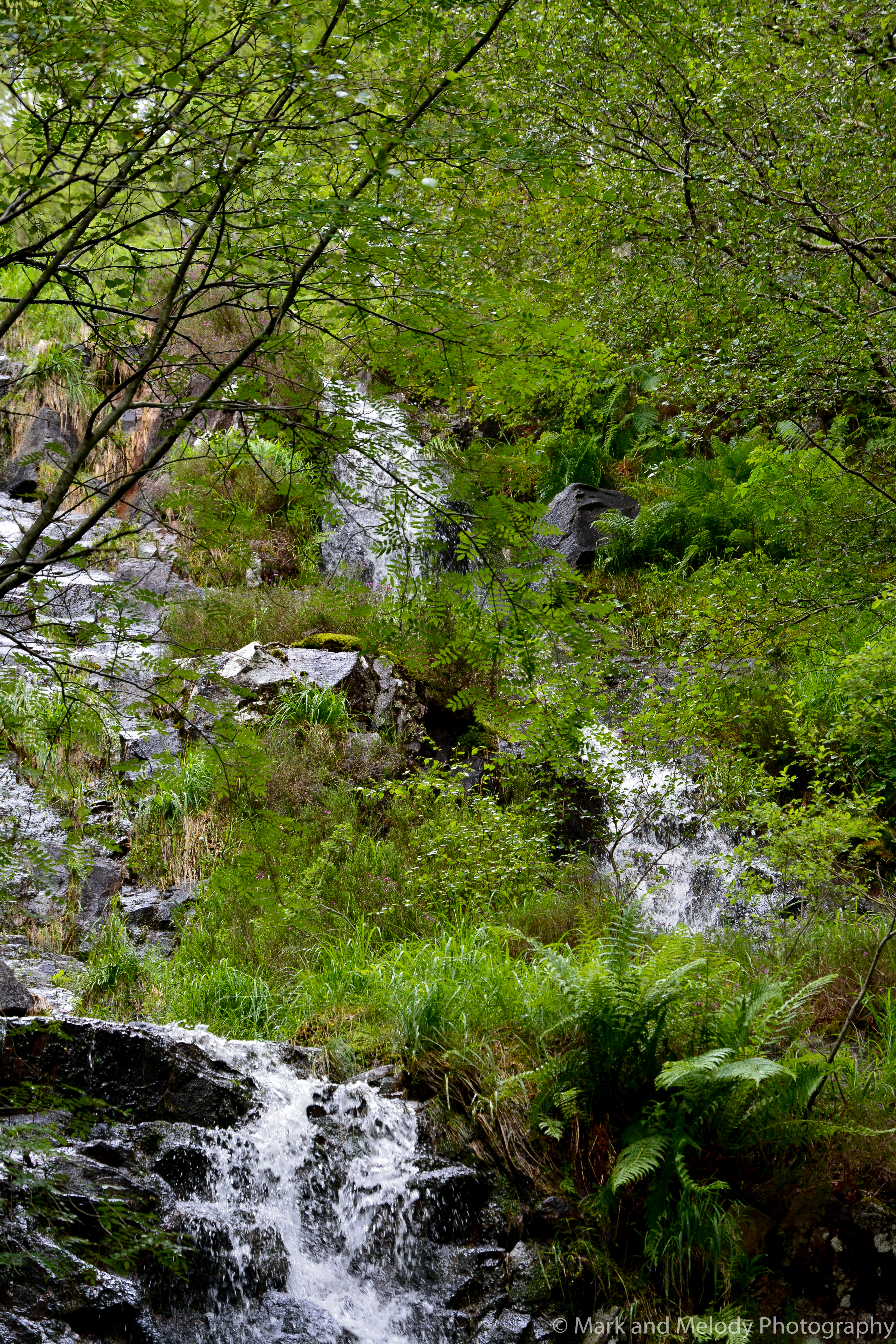
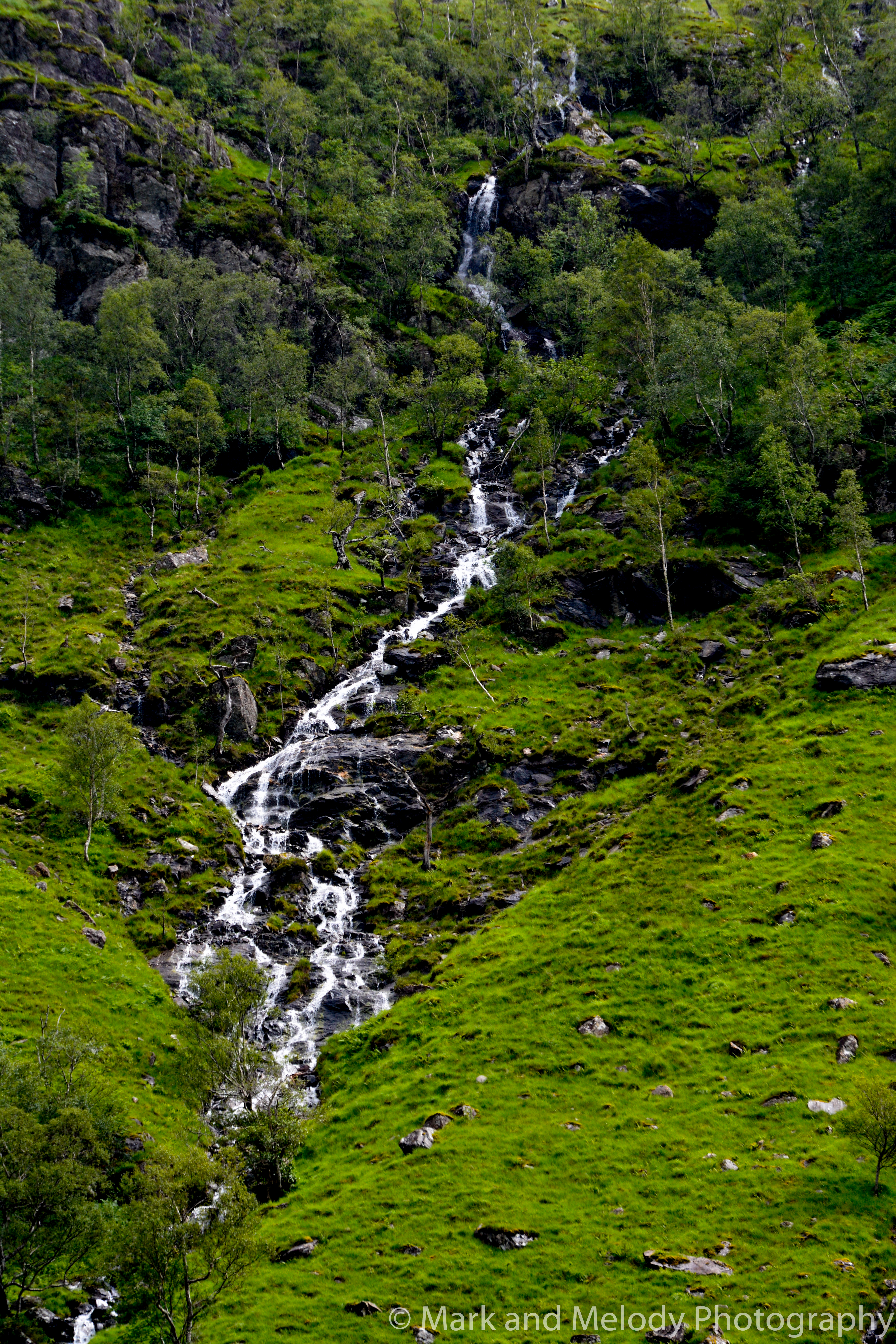
Hidden waterfalls like these are beautiful yet hazardous on the trail. Nike frees won't do you any good on this trail.
Hidden waterfalls like these are beautiful yet hazardous on the trail. Nike frees won’t do you much good here.
Pretty hard to contain my delight when there are little aquadrops everywhere!

The trail opens up into a field, where you’re in the valley of the Highlands and you can see the waterfall. It’s possible at the end, to get closer to it, and you can climb over the rocks, I recommend you bring food, at least a few snacks, to sit on the rocks and enjoy the picnic time and the view.

A little impromptu rock climbing!

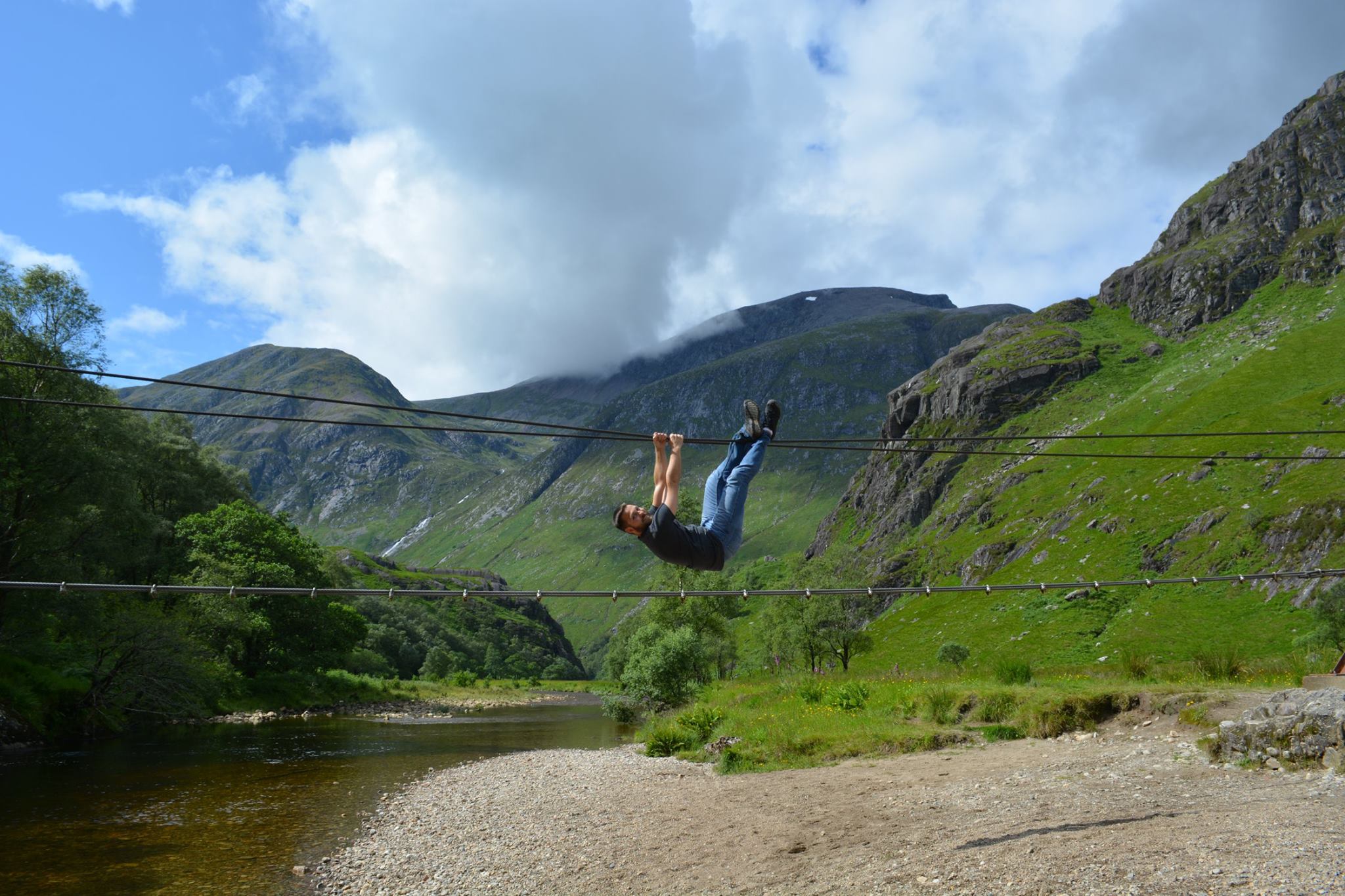
We brought cheerios and we wish we had brought more. Keep in mind this is a national park of sorts, so there’s no trash or rubbish bins. There’s a rope bridge, which looks a lot like a tightrope, you can cross, if you dare. It’s a bit scary, the first few steps, but as long as no one else is on it, shaking it or moving it about wildly, it’s an exhilarating experience. It’s also a lot higher up than it looks from the underside of it.

Mark turned acrobat on the rope swing I crossed with great trepidation.
Mark turned acrobat on the rope bridge I crossed with great trepidation. How about that view though?

However, once you get to the other side, there isn’t much to see, there’s a house, but not much after it. We thought we could get closer to the waterfall and wound up stepping into a bog and getting covered in mud up to our knees.

The hiking back as or seemed faster than it actually was to get to the waterfall. Maybe it was because I was tired or maybe it was easier after the hike there. There are plenty more things in the park to explore. It’s worth at least two full days, as there are waterfalls in nearly every corner and dramatic drop-offs everywhere you look.

That’s the beauty of the Highlands.

Waterfall spotting on our way back up the mountain
Happy hiking!

How to Be a Five Star Airbnb Guest

We’re big fans of Airbnb as a way to meet locals, experience authentic culture, and to find quality, budget lodging. Sometimes it can be difficult to determine, especially if you have a super relaxed host, what your responsibilities are. To earn yourself a five-star rating as a guest, abide by these tenets:

  • Most people loathe dishes in the sink, so wash them and leave them to dry, or rinse and put in dishwasher.
  • Minimize items left around the house. I’m really bad with this one, as I can be comfortable pretty much everywhere and thus my laundry, socks, and shoes tend to distribute themselves around any place of residence. It’s not messy; it’s a sign of genius. But if you have a host coming and going in the house, it can leave a bad impression of you. So if you’re like me and you enjoying occupying an entire space with your belongings, confine it to your room.
  • And close the door to your room, if for nothing else, because no one else wants to see your stuff, and you don’t want people seeing your stuff. If you’re a night owl like me and your day begins at 10pm (half kidding) then this also works to keep light and music in your room.
  • Ask to use the clothes washing machine!! Even if it is listed as an amenity, because odds are you’ll be using their soap too.
  • Recall your Aretha Franklin lyrics and R-E-S-P-E-C-T the space. Mark wants me to write to straighten the bed – fake make it – just in case something is needed from the room. This has never happened to us, where the host needed something from the room, but ya never know.
  • Understand personal time and space. The host might not always want to talk to you, and they’re not really obligated to. Most of the time they are working people too. We’ve had some quieter hosts and other hosts, like our lovely couple in Glasgow, that were happy to chat for hours.
  • Don’t eat food in the fridge or freezer unless you are invited to – if you finish something that you were given permission to eat or drink, offer to replace it.

And lastly…

Thank the host in person if they’re available – if not, leave a note / send SMS or E-Mail before writing and submitting your review. Airbnb will prompt you for a review at the end of your stay. If there’s any notes you’d like to offer the host privately, you can do so in a separate box after writing your review.

Let us know about your travels abroad, and as always, feel free to ask us for advice from lodging to low airfare.

Happy travels!

Mark and Melody

Surviving the Louvre: Getting to, Getting into, and Enjoying Your Visit

It’s no small task to visit the Louvre. Spoiler alert: this is not a leisurely stroll where you can really absorb what you’re reading. Why you ask? Unless one of your languages is French, you won’t be able to read any of the signs for the artwork. I don’t understand why other museums around the world can post signage in two or four languages, but for some reason the Louvre has decided not to do that.

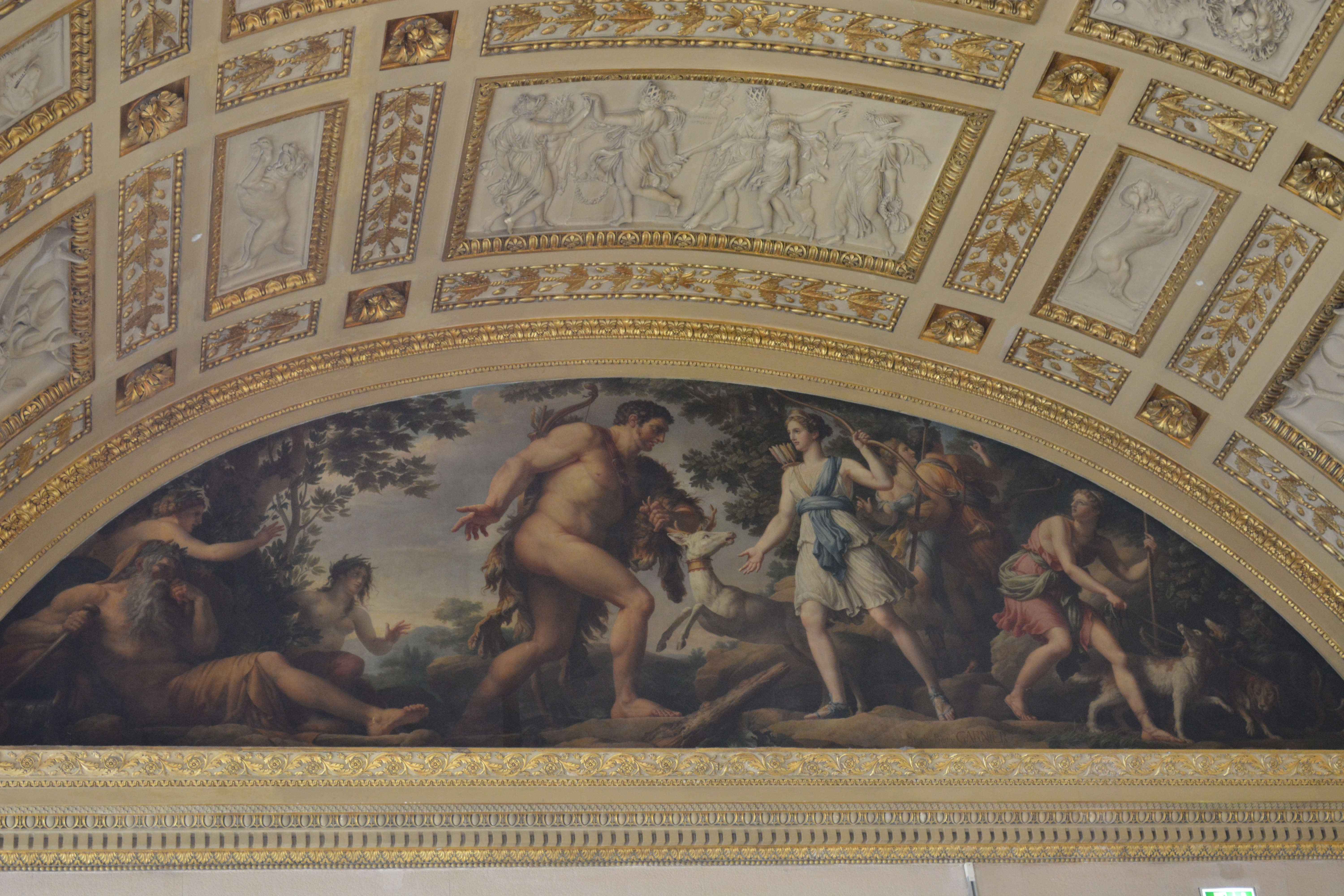
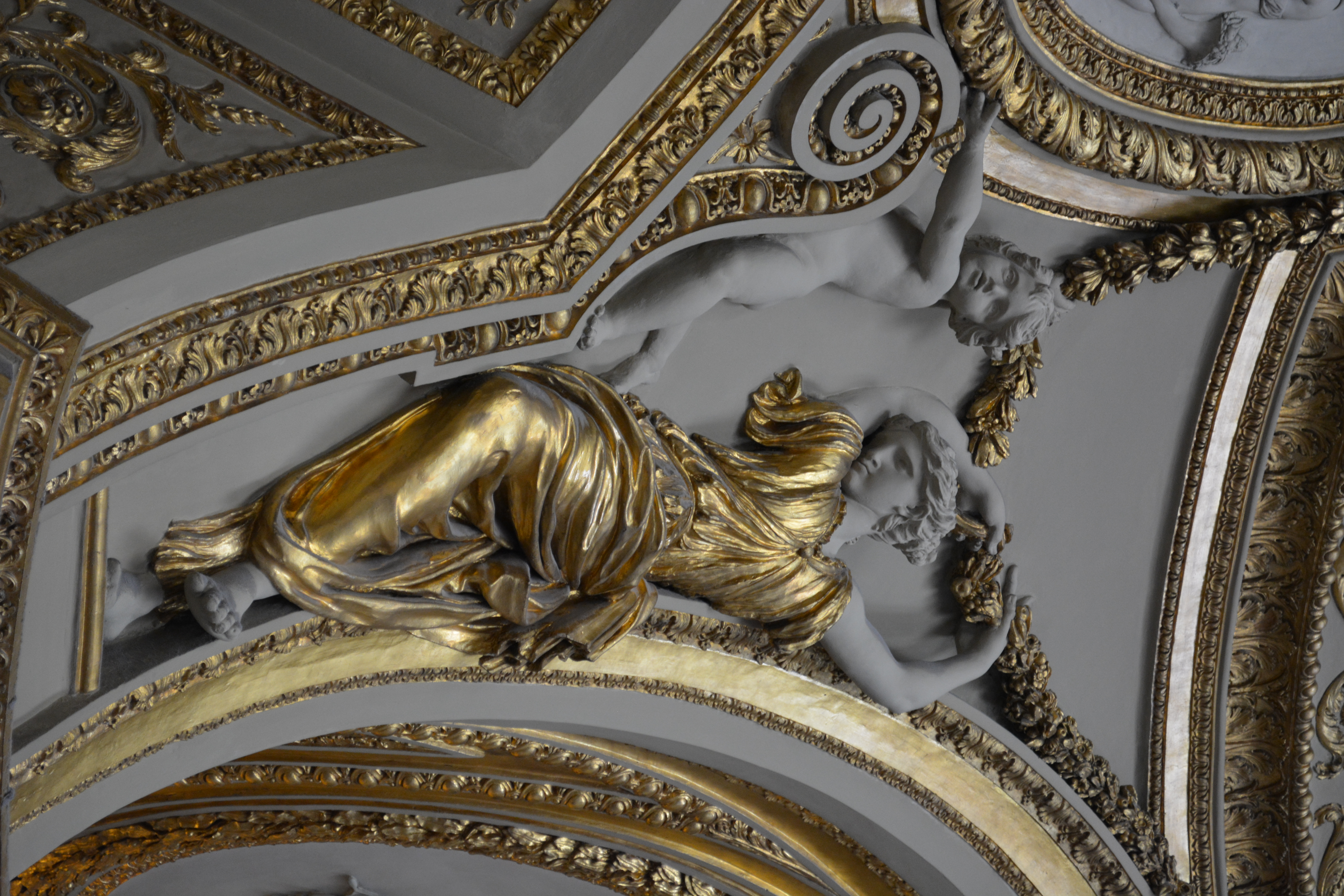
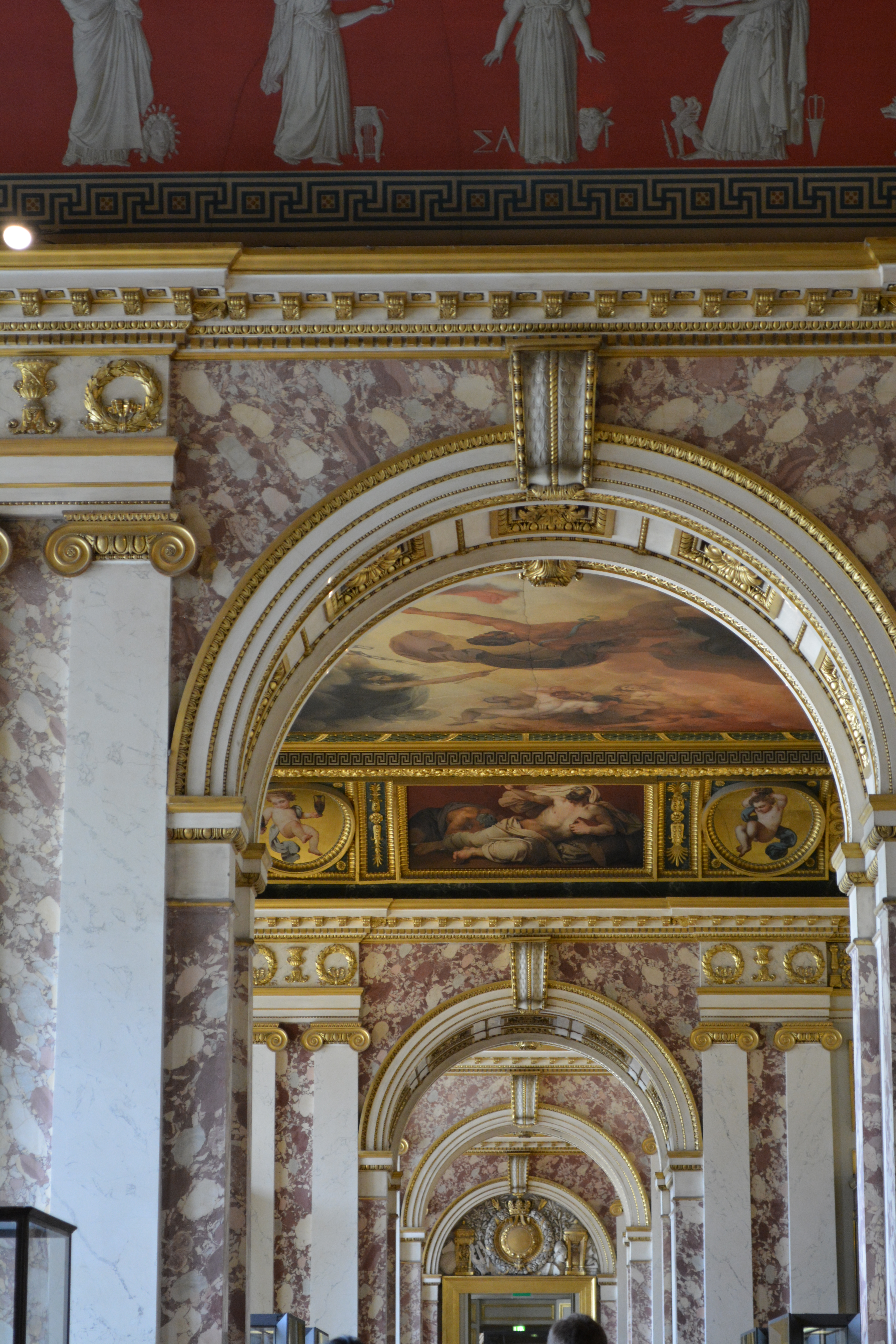
It’s an optic overload. The museum is housed inside of palace and that’s evidenced by the frescoes on the ceiling, the ornate gold on the walls and around the windows, and the sheer size of it.

One of the first rooms of the Sully entrance
Adorned in gold
Adorned in gold
Ornate hall
Ornate hall

Artifacts, paintings, and priceless memoirs of early human existence cover over 600,000 square feet/ 60,000 square meters of space. Three hours of moseying around this grand palace and my tootsies were getting very sore. There are ample places to sit, so they got that right.

Getting to the Louvre

Nearly everyone and their mom arrives via the subway/ metro, which dumps you into an exit where you arrive to the Louvre and you’re in fact surrounded by shops. This is really surreal, at least for me, because I literally uttered WTF while looking at the Apple Store – Thankfully it provides wifi. It’s just under the big glass pyramid.

Inevitably, there will be a long line jutting through the centre near where the two pyramids meet. This is the line to get through security. Note that if you are buying your ticket at the louvre, you must go through security first and then purchase your ticket at one of the counters that say, color me surprised, tickets.

Getting into the Louvre

Ticket machines and tellers are on the perimeter once you go through security. If you get lost look for the information desk, then focus your eyes past that and there’s a ticket area on the other side. Kind of brilliant really. If you have an international bank card that does not require a signature, you can use the ticket machines. Otherwise, you have to queue for a teller. Took me about two minutes on a Sunday afternoon, so not bad.

I picked up my ticket (€15 as of August 2015) and headed to the information desk to pick up a complimentary map of the museum. I thought it would be reassuring to know where galleries are at, but in fact it made me realize that there’s no way I could possibly cover it all.

So, focus on what you like. Do you like looking at marble slabs of rock hard abs carved by Michelangelo? Or would you rather see paintings? Or are you more interested in the Egyptian, Greek or Roman artifacts? (There are rooms dedicated to each). Pin this down before you get started to increase your odds of having a good time.

Then go to those first. I prefer looking at paintings so I can marvel at the texture, color composition, and the expressions on the subjects’ faces rather than Venus de Milo.

Disclaimer: Be honest with yourself. No matter how famous something is…if you’re not interested in that form of art, don’t spend the time, the patience and the energy looking for it and taking a mediocre picture of it. To take a picture and post it of something without knowing who the artist is or the inspiration of the work is a flimsy thing to do.

You don’t have to enjoy or give attention to every type of art. 

Honestly, after about three hours I was “arted” out. And I like art.

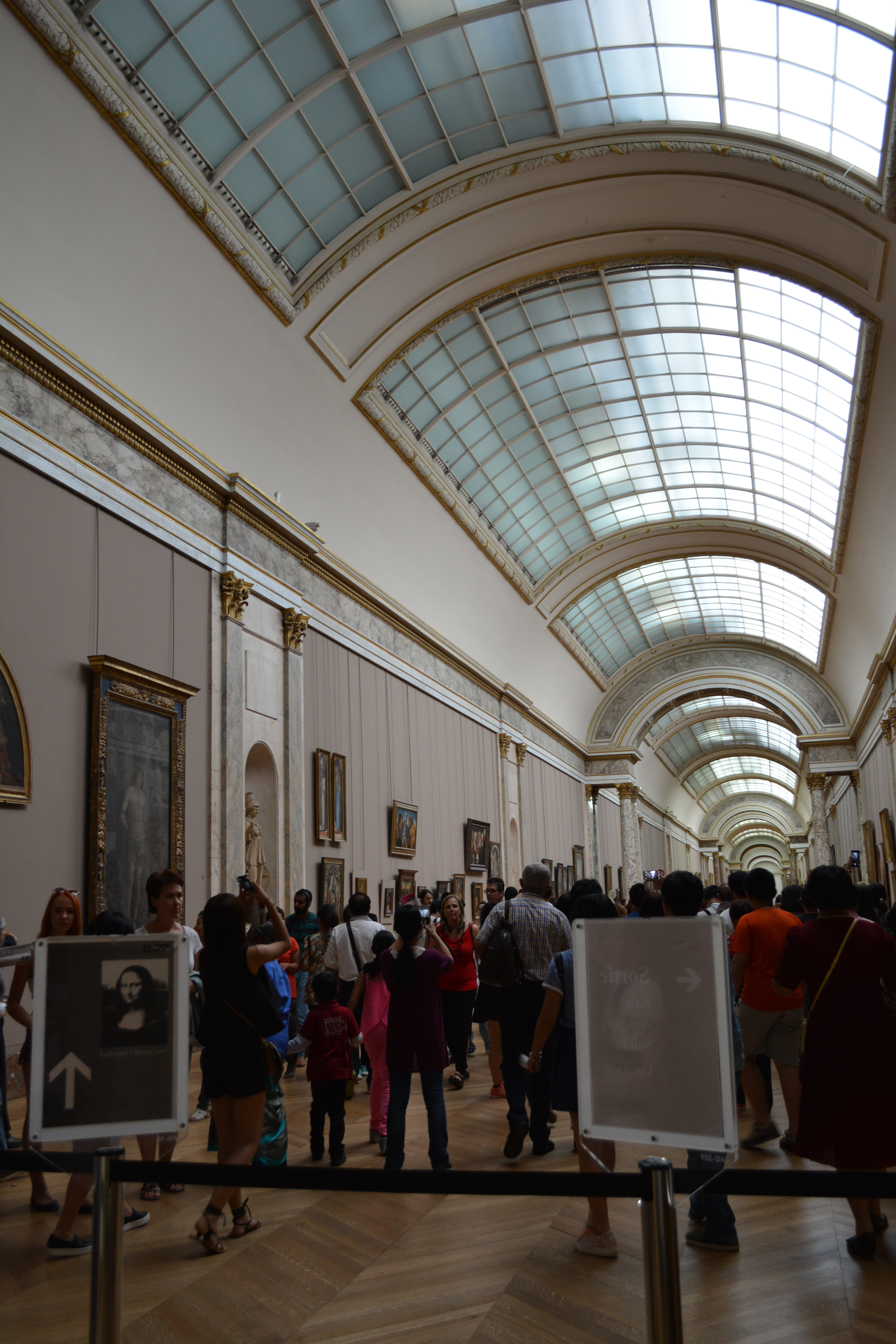
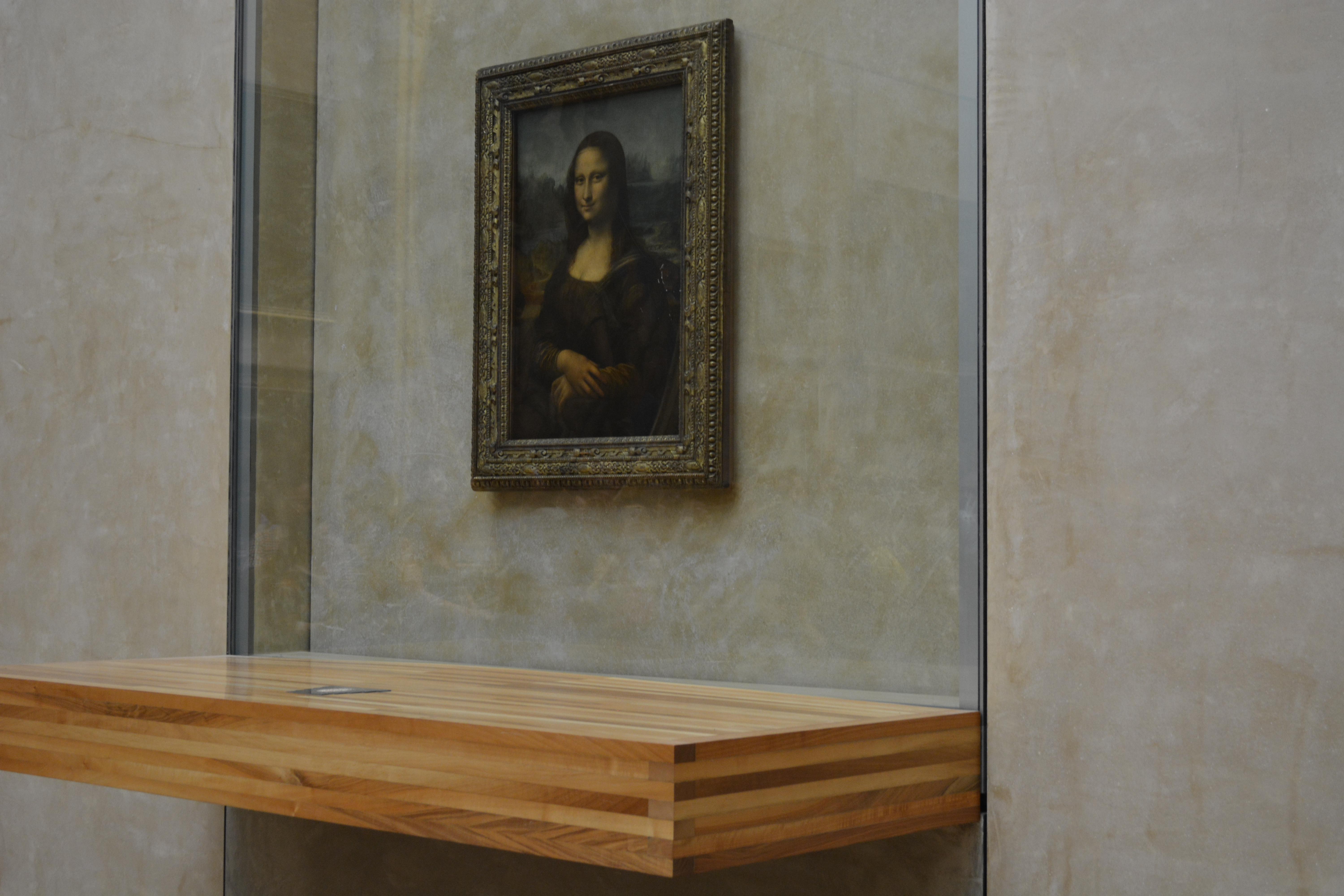
I saved the Mona Lisa for the end of my trip becaus I knew once I bore the brunt of the crowds I would be done with the museum. Turns out I know myself pretty well. There is signage everywhere pointing you to the Mona Lisa. It’s on the first floor in, naturally, the halls of the Italian paintings. On very busy days you will see a queue to see the Mona Lisa.

Entrance to the Mona Lisa. On especially crowded days the line begins back here.

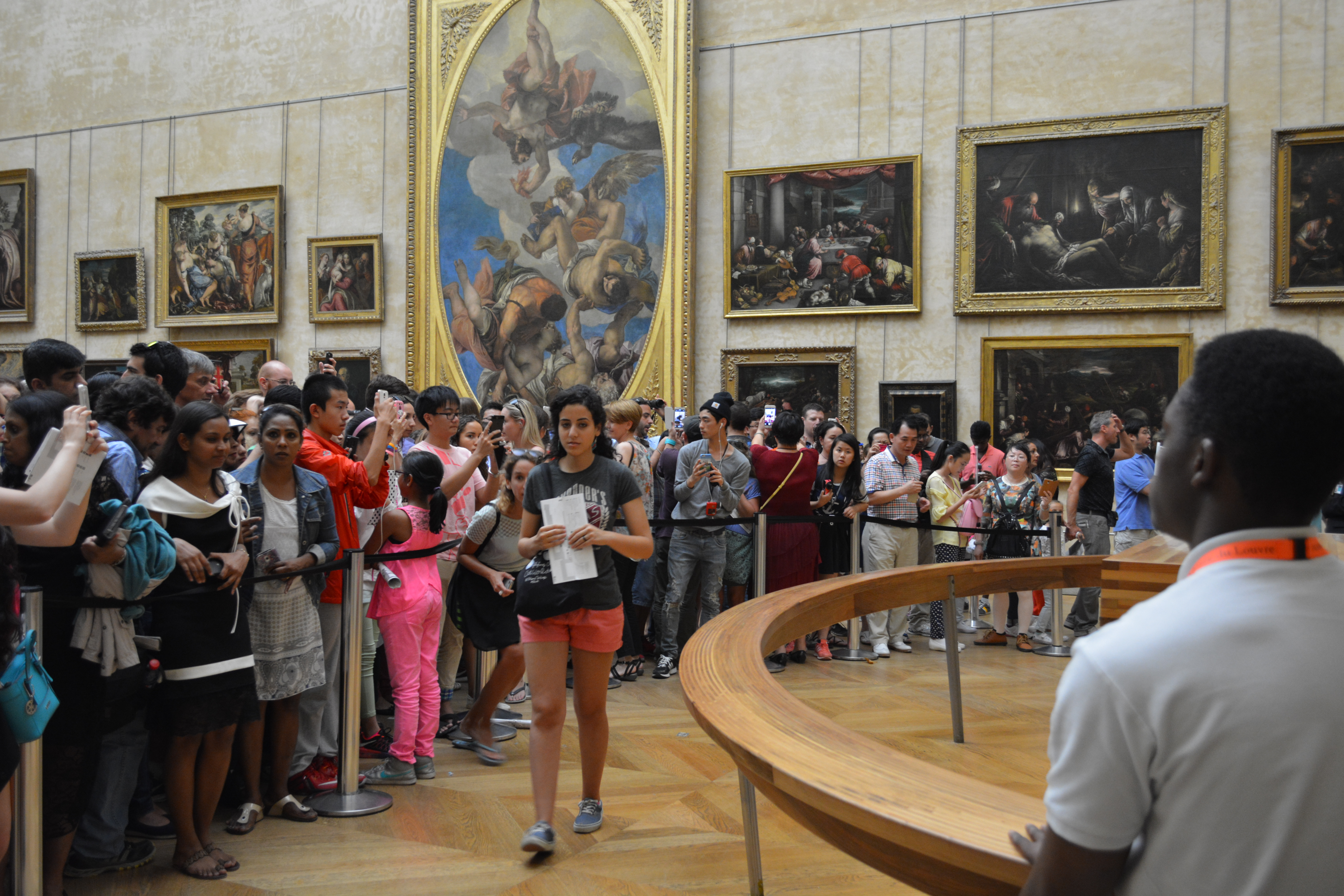
In this case, a Sunday afternoon, I was lucky to have to battle an arc of people about twelve people deep. When I visited the Mona Lisa in 2007, pictures were prohibited. Anyone caught with a camera was escorted out of the gallery. Now pictures are allowed, but no flash is permitted. Great, you’re thinking, except now we live in a world of selfie sticks and people jousting one another to make room for them and their selfie sticks. Not to mention its August, so it’s hot, and people are sweating, and odds are if you visit from March to September it will be smelly. That’s not too pleasant. So there’s people being smelly and being shovey and making  room for their selfie sticks selfishly and I kind of just wanted to hit them with it instead of admire the Mona Lisa.

The arc of people crowding around the Mona Lisa.
Mona Lisa, taken from the right.

I took my little picture of her cheeky little grin and found my way out quickly as the museum closes at 6pm (9:45pm on Wednesday and Friday).

I thought going a little more toward closing time would mean less of a crowd. Maybe what I experienced was a dwindle compared to what the day saw earlier, but half an hour to closing the place was still packed with people swarming everywhere like the Louvre is a hive. I stayed right until closing time and took the first metro home.

Tips to enjoy your visit:

  • Bring water and something to fan yourself with. The museum map works in a pinch, but in August it’s almost stifling warm.
  • Identify the art you’re most interested in seeing and start there.
  • Connect to the Louvre wifi and download the Louvre app. Plug in headphones. Insta-tour.
  • Carry some snacks to munch on while you’re browsing, because it’s a good ten minute endeavor to get from wherever you are to an exit.

When to go for budget travelers:

  • 18-26 are free on Friday evening regardless of nationally
  • 18-25 from EU, Iceland, Norway and Liechtenstein are free always (bring ID)
  • Under 18 is always free (bring ID)
  • Regardless of age or nationality, first Sunday of the month from October to March is free

Have you been to the Louvre? Looking to travel to the Louvre? Wanting to score unbelievably cheap flights to your next destination- click here.

Cheers,

Mark and Melody

The Only App You Need to find Cheap Flights Anywhere

Airfare is usually one of the “cost prohibitory” expenses for anyone looking to travel to a far flung place. Yes I know Asia is cheap, they may say, but the flight is so expensive. But are they right? For a long time, I believed it. I took a flight from West Palm Beach, Florida to Hong Kong and it cost over $1,200 in March 2012. Granted, Air Canada is a very nice airline to travel on but after planning our months abroad, Mark and I have found the omniscient, no fail flight app:

Skyscanner.

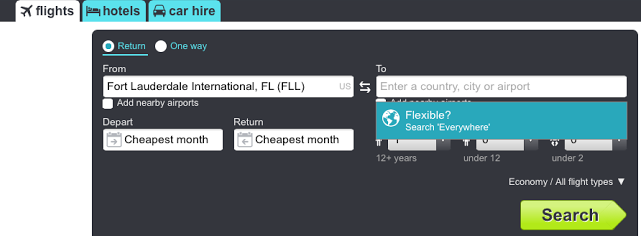
Skyscanner is a search engine that allows you find the cheapest airfare to any destination at any time.

Type in your home airport. For us, it’s Fort Lauderdale. Then we play our favorite game called let’s see what the cheapest destination is by typing “Everywhere” into the destination box.

Searching
Searching “Everywhere” will show a list of destinations available from your home airport. Anywhere in the world.

Now you can pick a month, or pick the cheapest month. Pick your number of travelers, make sure you have round-trip selected, and go! You’ll get a lovely list of all the destinations by country first. For most people in the US, US destinations will pop up first. Sometimes this isn’t the case though, because once it was cheaper to go to Mexico than it was to go to Chicago from Miami. 🙂

List of countries to travel to from Fort Lauderdale. Note: Prices are round trip per person!

A little further down, we see this list:

Batch two of options from Fort Lauderdale. Check out those European destinations!

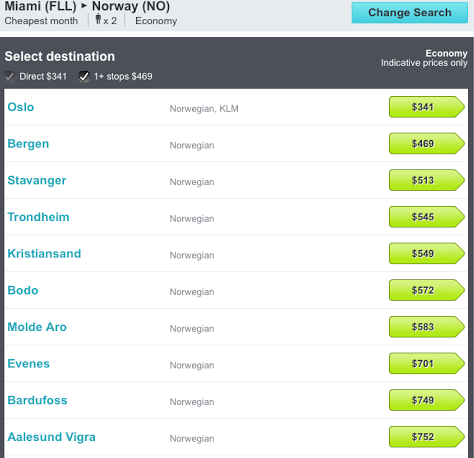
This is how we managed to get to Europe for $550.00. Yes, for two people! Once you find a country you like, click on it to see the destination cities. Let’s use Norway as an example:

List of cities you can fly to in Norway. Oslo looks like a good option, right?

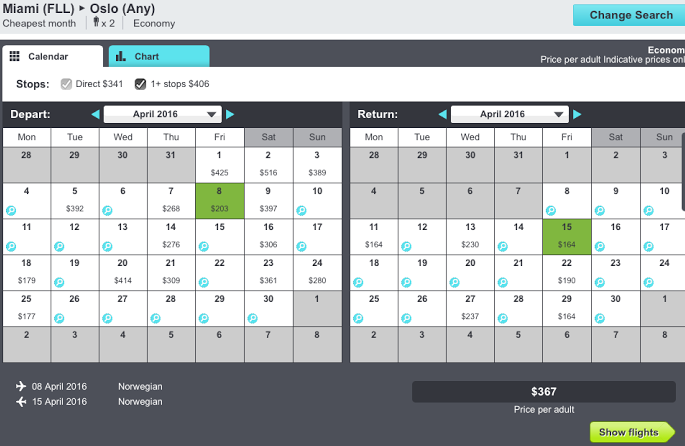
We just finished up a beautiful long weekend in Oslo, so let’s go with Oslo. It’s definitely feasible to take a day trip to see the fjords, or take a drive to neighboring Sweden. Remember that we selected the cheapest month, so when you select Oslo, the cheapest dates come up. Easiest vacation planning ever! No more determining the best time to go or for how long.

You have to select the departing and return dates, and the price you see on the dates is the price for that leg (example Fort Lauderdale – Oslo). But when you select both travel dates, your total price per person comes up:

Norway for under $400? Pack your bags!

Now that you’re armed with the best airfare finder in the industry, where would you like to travel next?

Let us know in the comments.

Happy travelling!

Mark and Melody