24 Hours In: Things We Learned in Brussels

Bruxelles, a heavily blended capital city, location of the European Central Bank, and port of entry to the rest of Europe. With exactly 24 hours to eat, drink, and experience, these observations sum up our feelings about Brussels:

  1. In August, it’s hot. People said it was unusual, but it was so hot we decided to go out and drink instead of stay in our flat with no AC.
  2. Incredibly weighty French influence which no one in the UK or Ireland prepared us for. Totally caught us off guard to be greeted with a Bonjour/ Bon Soir. We expected a Flemish dialogue, some Germanic influence perhaps, but it was predominantly French.
  3. Drinking age is 16. While American high school students tweet about a drivers license, kids in Brussels are legally ordering their first brew with their parents. This is a limited drinking license as hard liquor is still prohibited for under 18s.
  4. Many embassy guards for the U.S. Frequent a bar called Roosters, which has two lovely bartenders – one named Kelly and the other Anna. They are incredibly funny and knowledgable about the area and their beers are reasonably priced too!
  5. I had a romantic fantasy that living above shops near downtown would be, in the words of Gretchen Weiners, so fetch. Early in the morning I’d wake up and head to the place right beneath my flat, grab a coffee, and begin my beautiful breezy day. The flip side of that dream is that at night, there are a lot of loud drunk people crowding the entrance to your flat, and you have to sneak in between them and open the door. It feels so odd having tons of complete strangers know where you live…
  6. Hardly anyone accepts American credit/ debit cards, even with a chip. We had to convert to euros because our cards kept getting declined. Come into Brussels with some cash, or find an exchange place, but please don’t exchange currency at the bus station,or airport. It’s a total rip off. 
  7. If you want to drink and talk to tons of people from all corners of the world, ask for the Delirium bar. It’s a narrow street with a dozen entrances to bars dedicated to one type of alcohol. There’s a tequila bar. There’s a vodka bar where you order a liter of vodka. All of them sell beer, but if you really want to prove your worth to yourself and all the strangers around you, order a two liter chalice of beer. Take time to wander upstairs, downstairs, around. You’ll find plenty of interesting things to see.
  8. The food district of Brussels is made of narrow streets crowded by outdoor seating and hosts standing in the walkway. As your eyes wander over to the menu, you’re immediately approached by someone and asked if you want to sit. I found this really revolting as they give you no time really to look at the menu, so we kept shaking our heads no and walked out of the restaurant district to a quieter, less pressure cooker type atmosphere.
  9. If you’re staying at an AirBnB here, please ask your host what floor they are on. We stayed on the top floor which I thought was awesome until we arrived and had to climb EIGHT, count them, EIGHT flights of stairs up and down to enter or leave this apartment.
  10. Want to make this known that I asked for tap water at a restaurant, was advised they “don’t do tap.” I told her bring the cheapest water, she brought me €6 mineral water. Sigh. 

If you’re planning a trip to Brussels, know that it’s a small capital city, and two to three leisurely days can cover the main attractions. If you have any questions about where to go, what to see, or what type of food to eat, send us a message! 

Mark and Melody

Giant’s Causeway: Worth the trip?

A popular day trip. A UNESCO world heritage site. Should you drive or take a tour? Most of the day trip tours from Dublin were coaches, about 45 to 60 euros per person, which yielded two hours or less at the causeway. We figured that’s not enough time if we wanted to see everything. Do it once, do it right! 

So we decided to drive. Driving on the left is a. It of a learning curve but becomes pretty intuitive. We were worried when the GPS keeps lost service. Fun fact though, so long as you load your map before you lose service and don’t exit the map, you’ll have it navigating. The roads in Ireland are much wider than Scotland’s roads, thankfully, and the drive to Belfast was an easy journey. 

Please note:

  • Northern Ireland is part of the United Kingdom, which means
  • Speed limit changes from kilometers per hour to miles per hour. 
  • Prices are in pounds, not euros. 

Once north of Belfast (around Ballymena) the roads become much narrower and curvy. If you’re driving it, be kind to yourself and fill up your gas tank before you get to Northern Ireland. 

Be prepared for rain. It’s likely to come in five minute bursts so a raincoat with a hood is ideal. Hiking shoes are necessary as the land is quite wet and can be very slippery. 

We were more impressed by the hiking trails that the stones of the causeway. Yes, they are cool and hexagonal and it’s kind of fun to walk around them like stairs, but we would have been severely disappointed if that is all we had been able to do. To get the most out of the experience, you’ve gotta do a hike. 

We took the red trail, difficult, to the yellow trail challenging. Anyone in decent physical shape can do these hikes. If you can climb a couple flights of stairs, you can do these hikes. The best part of the hike is that it rained, because a beautiful rainbow formed from the cliffs over the ocean. It was absolutely surreal. The best part of being on the cliffs, overlooking the causeway and the ocean, was feeling so infinitely small. There is no greater reminde of how massive and powerful the ocean is when you’re looking down at its crashing waves. You know the water is freezing because you can feel the chill in the misting rain that’s coming down in bursts. It’s incredibly windy, so you know you’re pretty high up. We felt positively invigorated by the end of the hike. 

If you’re going to go, hear this to make the most of your trip:

  • To have more of the causeway to yourself, get there before noon or after 2pm to avoid the coaches full of people.
  • Want incredible scenery? Take the red or yellow trail. 
  • Bring a raincoat. 
  • Attempt to park at Giants causeway even if the parking lot is full. It’s much closer. If you don’t want to wait for a possibility, there is a parking area at the bottom of the hill that where you can park your car and take a shuttle. 
  • Wear shoes that are good in muddy terrain. 
  • Check out the gelato at the gift shop by the building where you pay the £9 entrance and parking fee. Super sweet woman runs the little place and she loves to chat. She also takes USD. 

Questions? Let us know! 

Five Awesome Free Things to do in London

London is a difficult place to keep on a budget. It’s really a buffet of things to do, history to understand, and information to absorb. In the madness and chaos that it is, there’s remarkably wonderful free things. After scouring the city for ourselves, we found the following attractions the best way to spend free time (as they can consume a lot of it) and keep your money in your wallet.

1. Imperial War Museum

Making bullets as the voice overhead observes Mark's job
Making bullets as the voice overhead observes Mark’s job

This is not any ordinary war/ history dull experience museum. There are voice overs, interactive whiteboards where you can touch and manipulate things as it shows you how long it took to create artillery, make bread or assemble shoes. There is gunfire and men and women shouting overhead. Lights are strategically positioned to make you feel like a time capsule has transported you back to The Great War. Incredible facts abound. We spent nearly three hours at the museum and didn’t finish the ground floor (there’s five of them). We learned:

  • Britain received gifts from all of her territories during World War I, including sheep, money, and food from Canada; rum from Jamaica; food and cocoa from Africa; and an assortment of goats.
  • Each participating military had its own unique outfit: colors, designs, emblems, embellishments, even if they were on the same side.
  • Germany’s army pushed Russia back an impressive 300 miles in one invasion! But it was not enough to defeat the Russians.

The museum is free of charge to enter; a map will cost a pound. There is also an entire floor devoted appropriately to the Holocaust.

2. The British Museum

Well done, Britain, this is an extraordinary place to visit. It’s also extraordinarily crowded, though people typically move about at a good pace. To avoid crowds, go on a Wednesday afternoon. I won’t tell you all the reasons you should go, because you’ve probably already put it on your list. But here’s the coolest parts:

  • Holding a 2,500 year old silver Greek coin, and learning that the symbol on that coin is on the Greek euro.
  • Seeing clocks from the 1500s. I watched the interactive video multiple times and I’m still convinced it’s part mechanics, part magic.
  • Seeing this poster which shows it’s cheaper to print on this currency than paper.DSC_0191
  • One of the first cash registers, created aptly by Tiffany and Co
  • The largest paper money denomination is 20 ‘million billion’ Hungarian. Wow.

3. The National Gallery

Simply wonderful. If you took your time through it you couldn’t cover the gallery. It’s simply stunning. People are milling about from the time it opens to the time that it closes. These pieces of art are so varied in size, emotion and structure. There’s one in particular, a painting of a horse that stretches from floor to ceiling. The walls are 20-30 feet high? The painting is so phenomenally large you’re captivated by the thought that one hand of one person painted this enormous horse. It’s held by chains that come down from the ceiling. 

The Gallery is best broken up into two afternoons if you want to really feel like you’ve experienced it. Suggested itinerary, do something paid in the morning then head over to the gallery for the later part of the afternoon. 

Van Goh's Most Famous: Chair, Sunflowers and Two Crabs
Van Gogh’s: Chair, Sunflowers and Two Crabs

Pro-tip: want to know what the fuss is about over an artist or a painting? Plenty of educated art enthusiasts at the entrance and exit of each gallery room to tell you about those works. Chat em up. 

BONUS: The buskers outside the National Gallery are extremely talented. There’s one gentleman, The Homeless Bard, who writes exceptional poetry detailing his highs and lows and major mistakes. Everything he writes is impromptu, spoken from the heart. Talk to him, he’s got a sweet drawl and tired blue eyes. He is optimistic, despite losing everything, and is currently rebuilding his life through his gift of penmanship.

Homeless Bard prays before writing his fourth poem of the day.

Finally, here’s a separate list of interesting places that are also free, but unfortunately we’re missed because of time:

4. Geffrye Museum – quirky and fun facts about the evolution of furniture throughout centuries. Even shag carpet has its genetic roots somewhere. And it’s always amazing to me how much SMALLER all the furniture is. An adult chair would maybe fit today’s child.

5. King George V Park evidently has alpacas, which are my favorite animal. If I ever had the opportunity to have land, I would certainly get a herd of alpacas. And feed them apples. Because they don’t have incisors that allow them to cut up food and all that.

Travelling to London and looking for more helpful hints? Click here to learn how to travel around London efficiently and cheaply.

MarkandMelody

Choosing Your First AirBnB

AirBnB has been truly great to us and we can’t recommend them enough. Every type of lodging is available: tree houses, huts, beach cabanas, modern flats and castles! Search functions allow you to search for a private room, a shared space, or the entire home. The prices vary as much as the style, meaning there is definitely a listing for your taste.

For accuracy in prices and availability, put in the dates you’re looking to stay, even if they’re tentative because you may find a place you like that happens to have a flexible host. It’s no fun to get super attached to a listing only to find out it’s not available. 😦

Before booking, check the cancellation policy. Each listing has one: flexible, moderate or strict. Flexible means you can cancel no later than 24 hours before your intended stay for a full refund, which is best for more spontaneous bookings. Moderate means cancellation must be made five days (in host’s local time) before intended stay for a full refund.  If you’re planning to attend an event or you’re pretty sure you won’t change plans, this is an option. Strict is… Strict. No full refunds are offered for Strict cancellation policies.  Instead, a 50% refund will be given for cancellations made seven days or more before your intended stay.

We’ve found the hosts to be quite delightful and to ensure you get the most out of your stay without any misunderstanding, we always message the host before booking. We also crafted a template to familiarize you with the site and ensure you ask vital questions with a message like this:

Hello, My husband and I are traveling to London from September 23 to September 28- confirming you have these dates available. We are mainly looking forward to visiting Westminster Abbey, Tower of London, and Camden Market. We would like to prepare a couple small meals as well. We will be arriving from Heathrow at 7pm- would you be home at that time? What is the best tube route to your location? 

Thank you kindly. 

Most hosts respond within two hours as they are eager to confirm guests :). Generally, a more outgoing, interactive host will respond with a more detailed message. Ask for recommendations in their area. If you’ve any allergies, it’s good to note that so the host can accommodate. We had an instance where a review noted a pet but the host didn’t, so if pets are something you need to avoid, confirm before the booking. At a different stay, I was totally under the impression the host would be there, but he didn’t live in the area anymore; the house was a rental property. For a first time stay, you may want to ask if there will be other guests in the house.

For short stay travelers looking to maximize time, ask:

  • What do you find is the best way to get around?
  • Is Uber operating here?
  • What times do the trains/ buses run?
  • Additional charge on public transit during peak travel times?

For super savvy and aspiring long term travelers, ask:

  • How far is the nearest market and when does it close?
  • How far is the nearest pharmacy?
  • Do you have ample pots and pans, flatware and cooking tools?
  • Do you have a clothes washer if I bring my own detergent?

For families of four or more, we recommend:

  • Selecting “entire house” instead of one room as a search filter. More privacy, flexibility and importantly security.
  • Booking as soon as possible if you’re attending an event. AirBnB hosts will raise prices too, sometimes three months in advance.
  • Letting the host know the ages of your children, especially younger tots.
  • If you rented a car, ask where the car can be parked. 

Final note: Give a host with no reviews a chance. We did and had a lovely stay!

Have you had an experience at airbnb you’d like us to feature? Let us know! We would love to hear your travel adventures.

Mark and Melody

Our Backpacking Gear – What We Use

This details our first attempt to follow this sage travel advice: “Lay out everything you want to pack. Now put half of it back.”

It’s really difficult to do. I began to think of all the possible scenarios in which I would need my makeup bag, three different kinds of yoga pants because it might be cold, or it might be hot. I wanted to bring ten tank tops because I love to layer, and I wanted to bring athletic shoes, hiking shoes, dress sandals and a pair of casual sandals because I want to make sure I’m accessorized and equipped for any occasion I may encounter.

But I’m carrying all this shit around for five months and that puts things in perspective. If you’re packing and you can’t lift your pack with one hand, IT’S TOO MUCH STUFF. And if you think it isn’t heavy, walk around your neighborhood for thirty minutes and reassess. If I had done that I’d have about a third of the stuff I do now.

We used the Kelty Redwing 50L Backpack ordered using Amazon Prime. We picked these packs for the following features:

    • Carry-on compliant for Ryanair, AerLingus, Norwegian. Win.
    • Front zip so the pack unzips much like a suitcase
    • Functionally sized side and top compartments
    • Highly adjustable shoulder, waist and chest straps – paramount for comfort and avoiding injury!


Melody’s Clothing:

Outerwear: one fleece jacket from Poshmark, one waterproof North Face jacket (lost in Istanbul).

Tops: Four long sleeve, three short sleeve, two tanks.

Bottoms: Two Jeans, One Yoga Pant, One skirt, One Pair of Shorts.

Little things: Two bras, one sports bra, one bathing suit, ten underwear, 1.5 pair of socks*.

Shoes: Leather Sandals (Aldo), Merrell Women’s Moab Ventilator Hiking Shoe

These hiking shoes have walked through farm mud, forest mud, slippery rock faces, sludgy trails, and everything in between. They provide enough stability for the ankles for a moderate hike, up to six hours in length.

Mark’s Clothing:

I think he overpacked, but he was prepared. His pack weighed over 20 pounds before we even left.

Outerwear: 1 insulated Calvin Klein jacket

Tops: 5 t-shirts, 3 long-sleeve shirts, 1 button down,

Bottoms: At least four trousers plus work pants, 1 pair of athletic shorts

Little Things: 10 pairs of boxers

Shoes: Running shoes, hiking shoes, casual shoes, and flip flops.

However, when we were ten days between laundry facilities, I was the one re-using clothes, not him. I’m actually surprised he didn’t run away when I was on my second or third wear of t-shirts.

That was my world of traveling light.

Electronics:

  • 1 17″ Dell Laptop
  • 1  iPad Mini
  • 1 iphone 4s
  • 1 iphone 6s
  • 2 Apple charging blocks
  • 2 Apple USB cables
  • 1 Car charger
  • 3 power adapters
  • 1 power converter block
  • 1 13″ Macbook Air*
  • 1  Nikon D5200
  • 1 External Hard Drive
  • 6 SD cards with carrying case
  • 1 Digital Camera Tripod

What Weighed Us Down

Melody:

  • Leather gloves – total waste in damp climates
  • Chi flat iron – adorable that I thought between the farming and touring a city I’d flat iron my hair. Nope.
  • iPhone 4s  –  used to send departing texts from Ft. Lauderdale on July 7th and never again
  • iPhone 4s charger
  • Oversized messenger bag – doubled as daypack and purse
  • Bulky plastic water bottle –  for refilling at water fountains but there’s never one around
  • Makeup bag. I gave up with makeup somewhere in August in Finland.
  • Nikon D5200. No getting around this. It’s heavy.
  • Two textbooks for my online classes

Mark:

  • 17″ Dell laptop – I wound up carrying this
  • Aluminum water bottle – bulky and makes the water taste funny

What We Tossed:

  • Mark traded his Nike free runs & Sketchers dress shoes
  • 4s iPhone Charger
  • Dead iPhone / iPad Charger
  • International Power Converter from Brookstone. All we needed for the phones, iPads and laptops were a handful of adapters.
  • Plastic and Aluminum Water Bottles
  • Melody’s mascara, eyeliner, ‘cheap’ foundation
  • Bra
  • Pairs of socks that got irreparably dirty

What We Bought:

  • Mark swapped two pairs of shoes for these NorthFace  Gore-Tex Hiking Shoes found at a TKMaxx in the UK.
  • Digital Camera Tripod from a Kodak Store ($30)
  • Full-size shampoo & conditioner to refill our many empty travel toiletries
  • Travel journals
  • *Macbook Air
  • International Power Adapters
  • Awesome Feetures Elite Ultra Light Socks. These make any shoe instantly comfortable with a compression band built into the sock that supports the arch of your foot. Translation: With these socks, you really can walk 500 miles.


What We Wished We Had:

  • Wool gloves for cold days
  • Box of Earplugs
  • Airplane Sleep Mask – the best one is this Alaska Bear sleep mask
  • More hand and face lotion
  • Emergency snack kits that we made before 5, 6 and 7 hour bus rides.
  • Cheap flip flops to walk around hostel in or to the car.
  • Slip-on sneakers. Many countries in Europe have a custom to leave your shoes at the door, and it gets frustrating untying and retying your shoes every hour or so.


Takeaway: You need a lot less than you think you do, especially if you’re traveling  from America. We wore the same week’s worth of clothes for five months and you’ll surprise yourself with the mileage you get out of your stuff. Make all of your clothes the same color-scheme (pinks, reds, and oranges or blues, greens, and browns) and you’ll go quite a long way.


The Oystercard Doesn’t Get You to London Airports, and other London Travel Tips

More about the benefits of an Oystercard and why you should by one in London here, but it’s a little known fact that it doesn’t cover transport all the way to ANY of London’s major tourist airports: Gatwick, Heathrow or Standsted. Instead, each airport offers its own express train. 

For flying into London Gatwick, please note, it’s about two hours from London City Center, so please calculate an additional $70 USD/ £40 for two people for the Gatwick Express to Victoria Station. From there you can buy an Oystercard and get just about anywhere in London via the tube/ underground. 

For flying into London Heathrow, it’s about an hour from London City Center. The Heathrow Express travels to Paddington station in 15 minutes for about $30 / £21 if you purchase in advance. To buy the Express ticket upon arrival into an airport it’s an additional $8 / £5 per ticket. 

For flying into London Stansted, there are two public transport options to get near city center. For $14/ £9, a 55 minute bus ride will take you from the airport to Liverpool Street. For $27/ £18, a 45 minute Stansted Express train will get you from the airport to Liverpool Street. 

NOTE: once you get to Liverpool street, you can use your Oystercard to get anywhere else on the tube, the overground, or the bus system. 

If you’re traveling with a group or you don’t want to deal with inevitable crowds, a third option is a taxi from Stansted which costs between $120-150 (£80-£100), though I’ve never taken it. You’re better off downloading the Gett app and hailing a taxicab that way. 

This is important so I’m saying it twice: buy your Oystercard in London. Do not get a travel card. Do not buy one-way tickets.  And please look hard at the London Pass before subscribing. The Oystercard lets you travel like a Londoner through nearly all the zones and you can refill/ top up the card as you go. 

Happy travels! 

Your Survival Guide to Driving in Scotland

The scenery in Scotland is world class. Traveled to over a dozen countries and it’s truly some of the most majestic landscapes I have ever seen. Scotland deserves independent exploration, some time to get lost in the incredible greenness of the area. After some frustrating, laughable trial and error, we can give you this must know list to make driving in Scotland much easier. 

There are four types of roadway: M, A, B, and C. The M stands for motorway, and that’s your typical highway (ex, M6, M74). A is secondary road, a busy two or four lane road (ex, A735, A82). B and C are curvy, narrow, back country roads.

The speed limit on these roads are in MILES PER HOUR, not kilometers per hour:

M roads: 70 mph

A and B roads: 60, but sometimes required to slow to 40 or 30 mph

C roads: 30 mph

This was discovered when we were going 60kph (37 mph) on a motorway designed for 60mph. No wonder we were getting passed right and left! Speaking on passing…

Odds are if you’re visiting Scotland, you come from a country that drives on the right. Your highways have the slow lane on the right, entrance and exit ramps on the right, and the fast lane on the left, toward the middle of the highway. In the UK, people drive on the left. This means the slow lane is on the left, the entrance and exit ramps are on the left and the fast lane is to your right. If you need to pass someone, you will be moving left to right. 

Love roundabouts. Scotland uses roundabouts instead of stoplights, so your GPS will be prompting you to take exits off roundabouts with about the same frequency you stop at a light in your hometown. Some of them are quite large, while others are the size of an intersection in a suburb community. Enter roundabouts by turning LEFT. 

Signs approaching a dangerous curve or severe dip in the road will tell you to slow down but not tell you what speed to reduce to. Generally reducing speed by 5-10mph will yield a more comfortable turn. But if you’re in a sports car and you want to power slide or attempt to drift,  just maintain and you’ll get a good thrill.

Drive during the day only. In the summer, the sun doesn’t set until 10pm. Many of the A, B and C roads are without street lighting which can be very dangerous. 

Taking a car around Scotland has proven to be taxing on the body and mind, especially with a manual drive car. Nearly all rental cars in the UK are manual: automatic drive is about twice as much. However, the scenery is more than rewarding and more than worth it. 

Safe travels! 

How A Missed London Flight Became the Best Day Ever

We had a flight from London-Gatwick to Oslo scheduled to depart at 6am. Following the guidelines of international flights, we decided to be there about 90 minutes early: 4:30. We were staying at Masslink Guesthouse so across the street from the airport. The alarm is set for 4am.

It doesn’t go off. Something wakes me up around 4am, but it’s not the alarm. I go back to sleep.

I wake up about an hour later, suspicious of how rested I feel. Light is peeking through the curtains. I know it’s not 4am. My eyes glaze over to the clock and in big red letters it proudly displays… Continue reading

Eating in Oslo is Outrageously Expensive

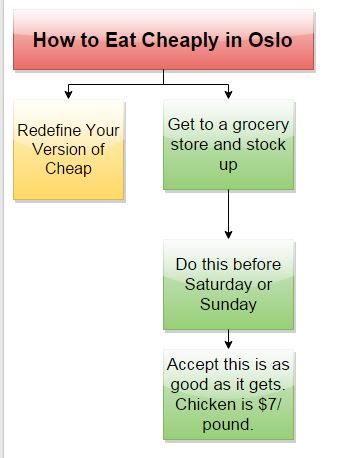
Eating Diagram

Oslo may no longer be the world’s most expensive city (it lost that rank in 2013), but it is still outrageously expensive. Unfortunately, for budget travelers looking to spend $50 USD or less, there is not a lot to do other than walk. Happy hour doesn’t exist here. Eating on the cheap doesn’t exist here. Thankfully the couple we are pet-sitting for left a fridge with some foodstuffs in it because otherwise we would DIE.

At an Irish pub, $120 was spent in Oslo on 2 Guinness, 2 ciders, a chicken club sandwich, Irish stew, and a whiskey.

We thought, no worries (actually Mark was like “WHAT!”), we’ll just eat from convenience stores and gas stations…

At a Shell gas station, $30 was spent on a Coke ($4), water bottle ($4), two Snickers bars, a muffin, and two hot dogs.

We learned that the city pretty much shuts down in July and it is cheaper to spend a month anywhere else in Europe than it is to stay in Oslo. We learned this after we walked around Oslo looking for cheap eats courtesy of Yelp, but two of the places we went to were closed.

We wound up… at a Norwegian version of Chipotle (one of two places open) where two burrito bowls cost $30.

We’ve finally given up on dining out, even as a treat, so we relegated to finding the grocery store. Only to discover…

Grocery stores close at noon on Saturday and are closed on Sunday.

When I said I wanted to lose weight, this is not what I had in mind.

Don’t Rush into the London Pass

We almost bought them. It seemed like a great deal, which is reason to be all the more suspicious of it. In short, it gives you access to 60 attractions for one, two, three or six days, including things like Tower of London, Westminster Abbey, a Tower Bridge Experience, Windsor Castle, Globe Theatre, and a Thames River Cruise. The price for the pass goes up naturally with the number of days you plan on using it. It all sounds perfect, right?

Here’s why I didn’t get it. You have to see a whole lot of attractions in order for the pass to save you money. For example, I wanted to see:

Tower of London: 22
Westminster Abbey: 20
Beefeater Gin Distillery Tour: 12
Chislehurst Caves: 6
Jewish Museum: 8

Equalling 68 pounds. In order for the pass to save me any money, I would have to do these things in one day with the one-day London Pass, which costs 52 for an adult, which is frankly insane for the following reasons:

  1. We were at the Tower of London (where the Crown Jewels are) for over three hours and made it through the history of currency and mint exhibition, the White Tower, the Crown Jewels, and the Bloody Tower. There’s no way to see the entire Tower in less than half of a day.
  2. The Beefeater Gin Distillery is across town and takes another two hours in itself.

We took pictures of Westminster Abbey (not all that interested in the lineage of the royal families) and haven’t made it to the other attractions but the point of this is:

You would have to be hustling through major points of interest to save any money with the pass.

What would you prefer – spend a little more money for a lot more leisure, or save a little money for a lot more stress (and possibly pain?)

BUT, If you insist on purchasing the London Pass, please pick it up from a vendor in London. Buying it online will cost you an additional 10 pounds or more. (We saw rates much cheaper in London in person).

Leave comments with questions. We’re happy to elaborate.

Cheers.

xx

Travel Diary: Battling Sickness in the United Kingdom

You don’t always need to catch a virus or get invaded by bacteria to get sick. Sometimes you try to do so much, so quickly, with such vigor, that your body literally breaks down and forces you to stop.

That’s what happened. After walking about 30 kilometers (18 miles) over 2 days, our bodies said, “Enough.” Naturally, we went on a hunt for some pain relief. In the UK, the equivalent of a CVS/ Rite Aid is Boots. Boots has a bunch of cosmetics as well as a pharmacy and some minor first aid items. We picked up some throat losenges we thought would do the trick.

No dice. Earlier today I went to an establishment that said simply ‘Pharmacy’ on it. I went in and that’s exactly what it was. Two pint-sized aisles of what seemed like space-filling items, and a whole wall after wall of drugs behind a pharmacy counter that a young pharmacy student was manning. After a bit of browsing items that had absolutely nothing to do with my pain, I walked up to this pharmacy student and said simply, “I have sinus pain and a fever. What should I get for that?” He simply nodded and turned to the pharmacist, who scanned the myriad of shelves for an item and handed me some intense looking sinus/ fever reducing SudaFed (4 pounds).

The main purpose of this is to illustrate that you cannot buy any pain relieving/ fever reducing/ cold or cough suppressants without first speaking to a pharmacist. You go up to them, or queue up (wait in a line) to talk to them. No charge. You tell them your ailments, and they fix you.

Note: Please tell your pharmacist what you’re taking or if you’ve had any alcohol or aspirin in the previous 48 hours. They don’t always prompt you for this. Anything, even contraception pills, can have adverse reactions when taken with certain medication.

What We’ve Learned After 3 Days in London

Our first stop on our 111 day journey around the world takes us to London. What a city. We had a lot of expectations, both of ourselves and of the city. Here’s what we’ve learned with a little bit of tough love from one of the world’s most cosmopolitan places, and see this link for how to do London on a Budget.

1) This is not a bargain town. With the USD-GBP exchange rate, we’re getting about 64 pounds for every $100 USD. Here’s a point of reference, all prices in pounds:

Cheap beer: 4
Nice beer: 6
175 ml glass of wine: 6-8
Appetizers (half the size of American apps so a bad substitute for dinner): 9-12
Cheap dinner: 13
Filling Dinner: 20-30

So you can see, a nice (non-budget) dinner for two could easily eat up your 64 pounds.
In other words, you’ve just spent $100 on one meal.
No tipping here. Please don’t do it. And no added-on tax. The price you see on the receipt is what you pay.

Picking up foodstuffs from supermarkets or grocery stores is key to saving money.

Cold/ Flu Medicine: 4 [please see note here about pharmacies in the UK]
Small bottle of water: 1
Large water: 2
Takeaway pasta from grocery store: 4 (or you can get lucky with a 3 for 3 deal at Sainsbury’s)
Box of tea: 2

NOTE: There are Panera Bread type places where you can purchase coffees, smoothies and bread items, but you will see two prices: a takeaway (to-go) and eat-in price. The eat-in prices are higher because of a VAT (value added tax) charge. Our suggestion? Get your items for takeaway and eat at one of the numerous parks and green spaces.

2) Please be extremely mindful of the amount of walking/ stair-climbing you do. It is very easy to wear out your body and thus make yourself sick. London is very walkable, but please please plan your visits to attractions in clusters and plan for no more than three attractions a day. It is not necessary to visit the Imperial War Museum and the National Gallery in the same day. They are on opposite sides of town and there is plenty in each “zone” to keep you busy for an entire day.

3) Buy an OysterCard the day you arrive (and think twice about the London Pass). They’re available at the airport, convenience stores, kiosks, and supermarkets. It gives you access to the tube (underground subway), the overground (above-ground subway), and the buses for very low prices. We took a bus during the tube strike: they’re great. Note: As of July 2015, the tube does not run 24 hours; in September 2015, 24 hour tube operations are scheduled to begin.

4) If you have an unlocked phone that can take a different SIM, we strongly suggest you seek out a LycaMobile SIM for 1 pound. The plan we purchased was 17 pounds and came with 2000 minutes, 5GB of data and unlimited text messages. This means we can load maps on Google with the route/ directions, put the phone on airplane mode to save battery/ data, and use the pre-loaded map. Genius. It works. It saves battery. We haven’t gotten lost.

Cheers.

xx

Snorkeling at John Pennekamp State Park – Know Before You Go!

As part of our ambitious desire to visit every state park, we thought a snorkeling adventure at John Pennekamp Coral Reef State Park would be an easy and fun addition to our list. We called the snorkeling crew down in Key Largo and made a reservation over the phone a day before. The next morning, we made the drive to Key Largo.

The park is easy to find with plenty of signs directing you. Like any other state park, it’s a $6 entrance fee to the park for a car with 2-8 people. With your receipt you’re given a map of the park and some history of the area.

After you park your vehicle you’ll see an education center with some wildlife and conservation information. A little further and you’ll see the area where you’ll check in, which is the gift shop and activities check-in desk together..

The conditions for the water are listed on a whiteboard when you go to check in which details the level of choppiness and visibility in the water.

They have mask, snorkel and fin rentals available in case you don’t bring your own, but I definitely suggest you find your closest WINGS store and pick up a set there. Buying a mask/ snorkel set at Pennekamp will cost a hefty $30.

Fortunately, the people at John Pennekamp don’t make you pay in advance. Unfortunately, we and two other people signed up for the snorkeling adventure and drove about two hours to get to the park. We got to the counter, big-eyed and bushy tailed, ready to snorkel to our hearts’ content when we were told…

The water is too choppy. We might not be running the tour today. If we do run the tour, you will need to be an experienced snorkeler and a strong swimmer.

FYI: I’m not the world’s strongest swimmer. Mark’s never snorkeled. The couple we were with had both snorkeled and swam, but they weren’t keen on bobbing about in choppy waters. We decided to have lunch and see how we felt about going. When we went back inside, we were told that the waters were still really choppy (the wind was gusting at about 15-20 miles per hour) and good visibility wasn’t guaranteed.

Translation: The current is kicking up a bunch of sand and you might not actually see shit.

With the tour being about $40-50 a person including the gear rental, we decided that going snorkeling on a super windy, super choppy day wouldn’t be the best idea for first-time snorkelers.

Alternative plan: We asked about the glass-bottom boat tour, but were told the choppy waters were churning up the sand and reducing visibility on the boats as well.

So, what’s a group to do in John Pennekamp if you’re not snorkeling/ glass-bottom-boating?

It turns out… not a whole lot.

There are three small beaches where you can put your towel down or post up some chairs, but the sand is packed hard and it’s really uncomfortable to lay on. There’s a few boardwalks, and there’s kayaking, but we went kayaking at Oleta River State Park the day before, so our upper bodies were sore.

We wound up leaving about an hour after lunch and headed to Crandon Park, near downtown Miami, for a classic cityscape photo shoot before driving home.

Pro-tip #1: Make a reservation a day before, then call before you leave and ask about “if the conditions are clear, the waters are smooth, and if we can see the statue.”

Pro-tip #2: Buy your own mask and snorkel, even at a drugstore. It’ll be cheaper and function just the same. And you can keep it.

Ciao!

Why Do You Travel? Reply back with yours!

Why would anybody pick this life?
Why would anybody try?
To move about, and run about
And roam from home to home

Why would anybody pick this life?
It heightens all the fears
It wears you out and breaks you down.
It reduces you to tears.

Why would anybody pick this life?
It’s not the path of ease; in fact.
You’ll find it’s just the opposite
But opposites attract

If we get to pick our chains
I hope that restlessness jails me
To a life that moves from plane to train
Destination: I’ve yet to see

If we get to pick our chains
May I be bound to road and sea
To a life that’s redefining
Predictability

If we get to pick our chains
I’ll take my second class billet
Over a plush corner office
And a two-week holiday.

😉

Ciao.

3/161: Lover’s Key State Park

I’m pretty sure we’re list freaks.. We find a list of places  and decide to do it. (48 contiguous states? Check. Every country in the world? Wellll, that will take a little longer, but we’ll get there eventually…)  Thinking a little bit closer to home, we decided to go visit every state park in Florida. Good news! There’s 161 of them. 

Living in Miami wed never known there’s that much land to make state parks OUT of. Here we are, though, at #3: Lover’s Key State Park. It’s about two hours to drive across the state to Ft. Myers, and it’s well worth a visit. A $2 donation will get you in (honor’s system!). Park your car, no fees, no frills, just a really good beach.

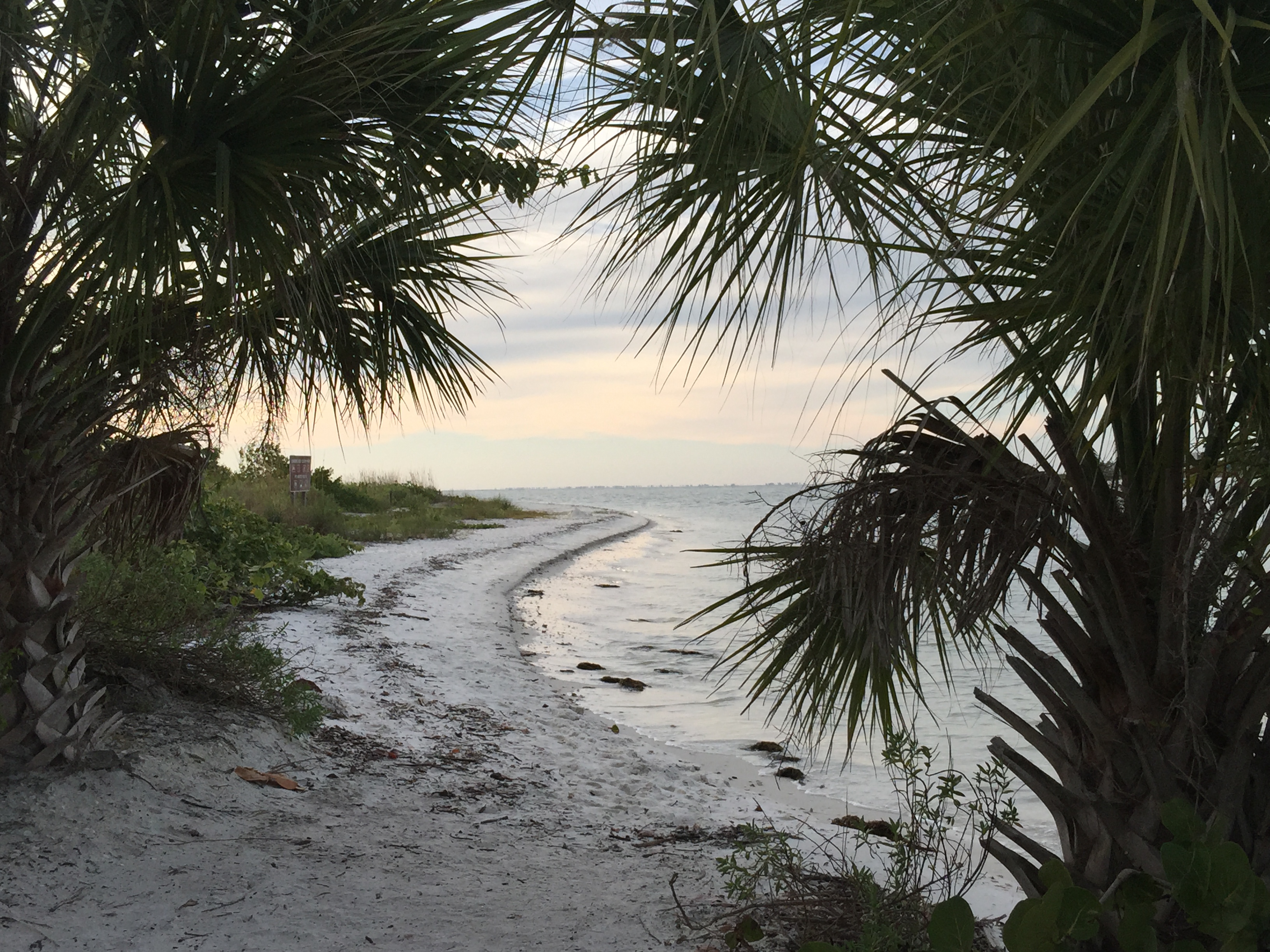
IMG_0670

Let’s describe the sand. Oh, the sand is like baby powder. So gentle and fine and so beautiful you don’t mind it creeping in your shoes or between your toes. Even when it’s hot the sand remains cool. (This is not so on the East Coast, where the sand from the Atlantic Ocean will burn your toes right off!). OK. Enough about the sand. The water. Crystal clear. Even after a storm it’s clear. It’s got this turquoise almost island tint to it. It’s beautiful. Refreshing and clear. You can see every speck of baby powder sand.

Then there’s the things to look at. Seashells. Sand dollars. Sponges. Real live sponges. Coral. Crabs (not the bad kind, the scurrying across the sand kind). Most importantly, the beautiful lack of people. Though the parking is right off the main road, it really  feels like you have the place to yourself.

Close up of a sponge
Sponges vary from a beige to orange to a bright red
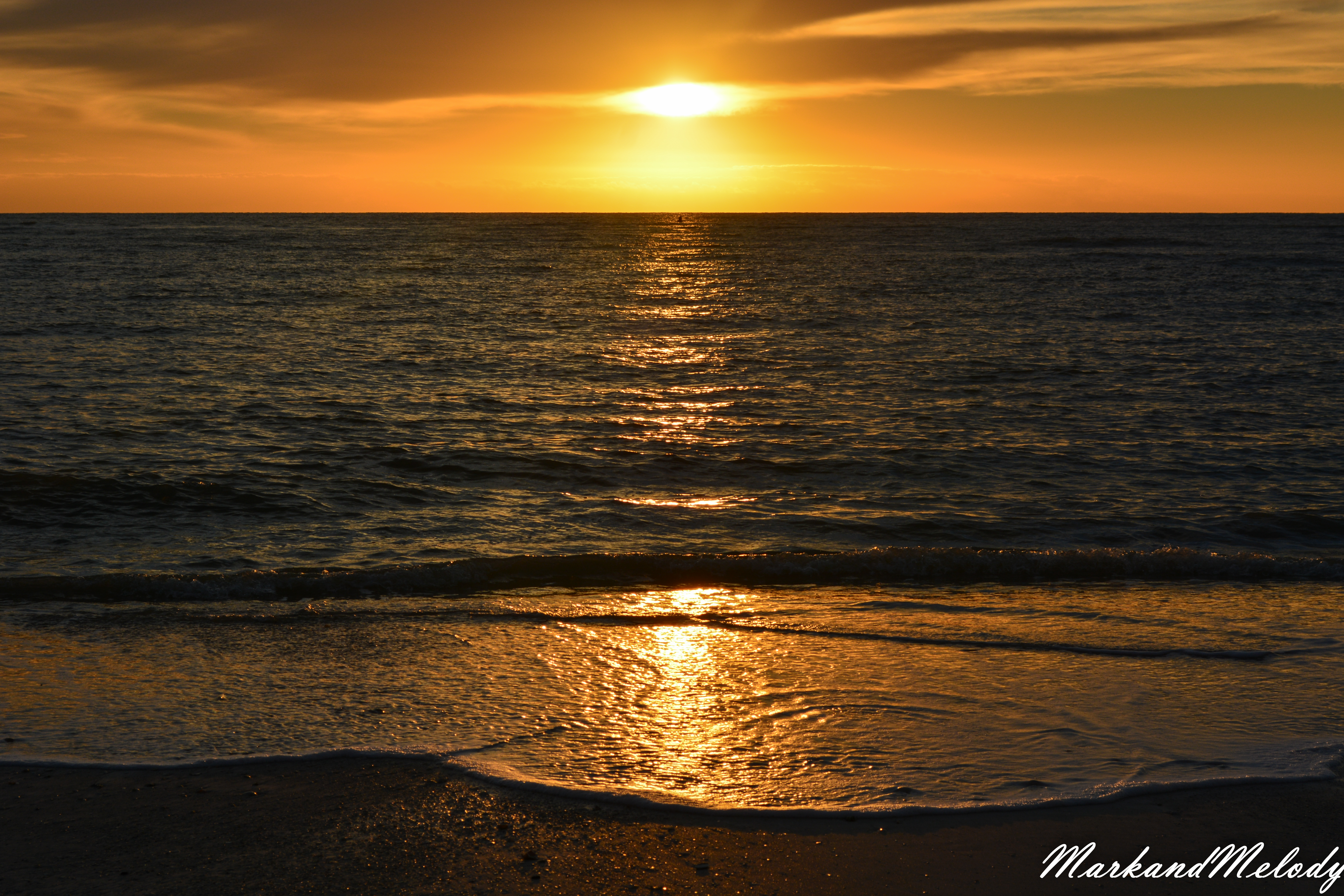
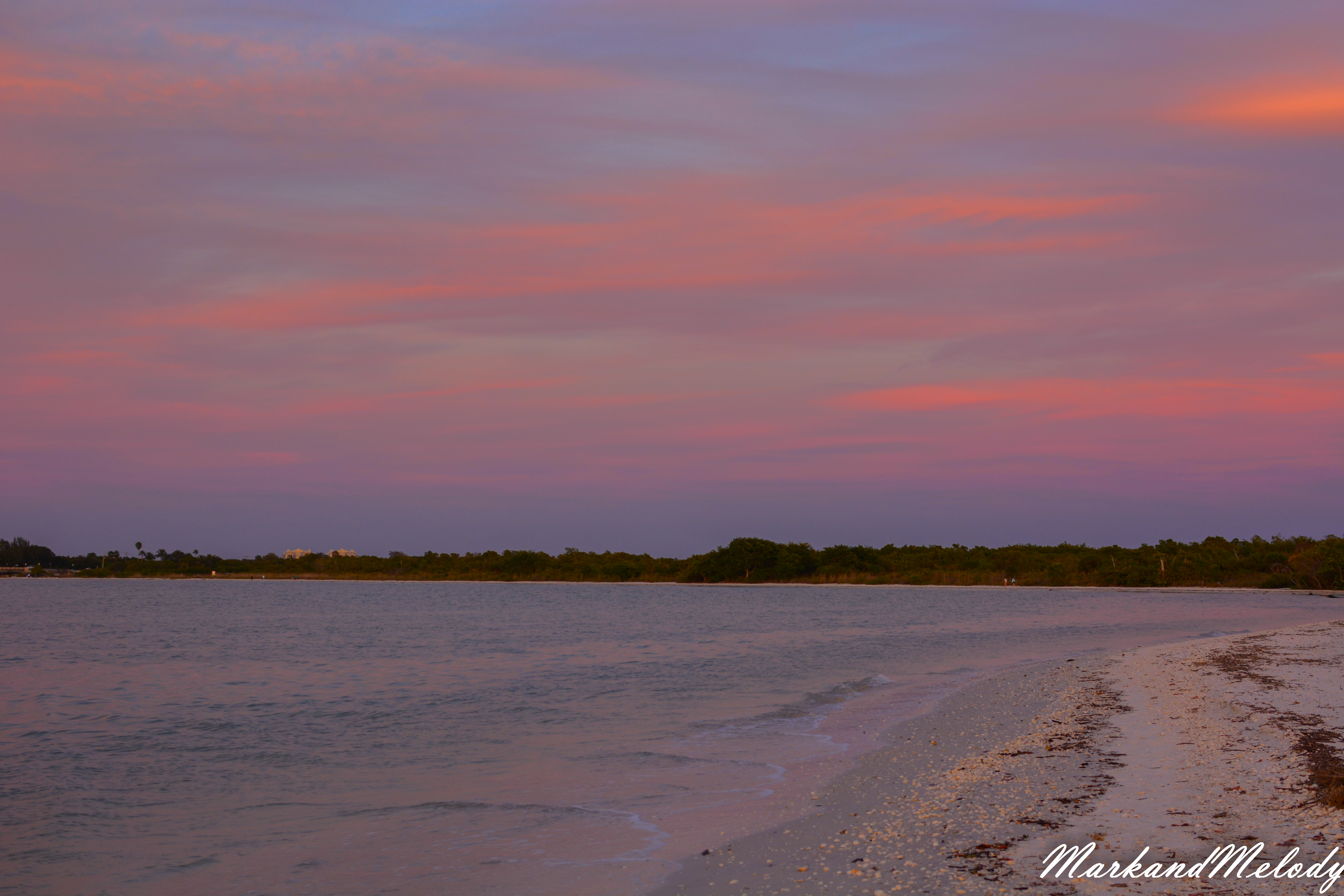
We wandered to the back of the park to have the sun right in front of us. No matter where you are on the Gulf Coast of Florida, you can’t go wrong with the sunset. This is a great place if you are the kind of person that likes long walks on the beach. Here’s our favorite sunset shots: Let us know which view you like more! 
 
To the west, a big orange ball sinks quickly into the Gulf.
To the east, cotton candy clouds  of pink, blue and purple cover the sky.
To the east, cotton candy clouds of pink, blue and purple cover the sky.